




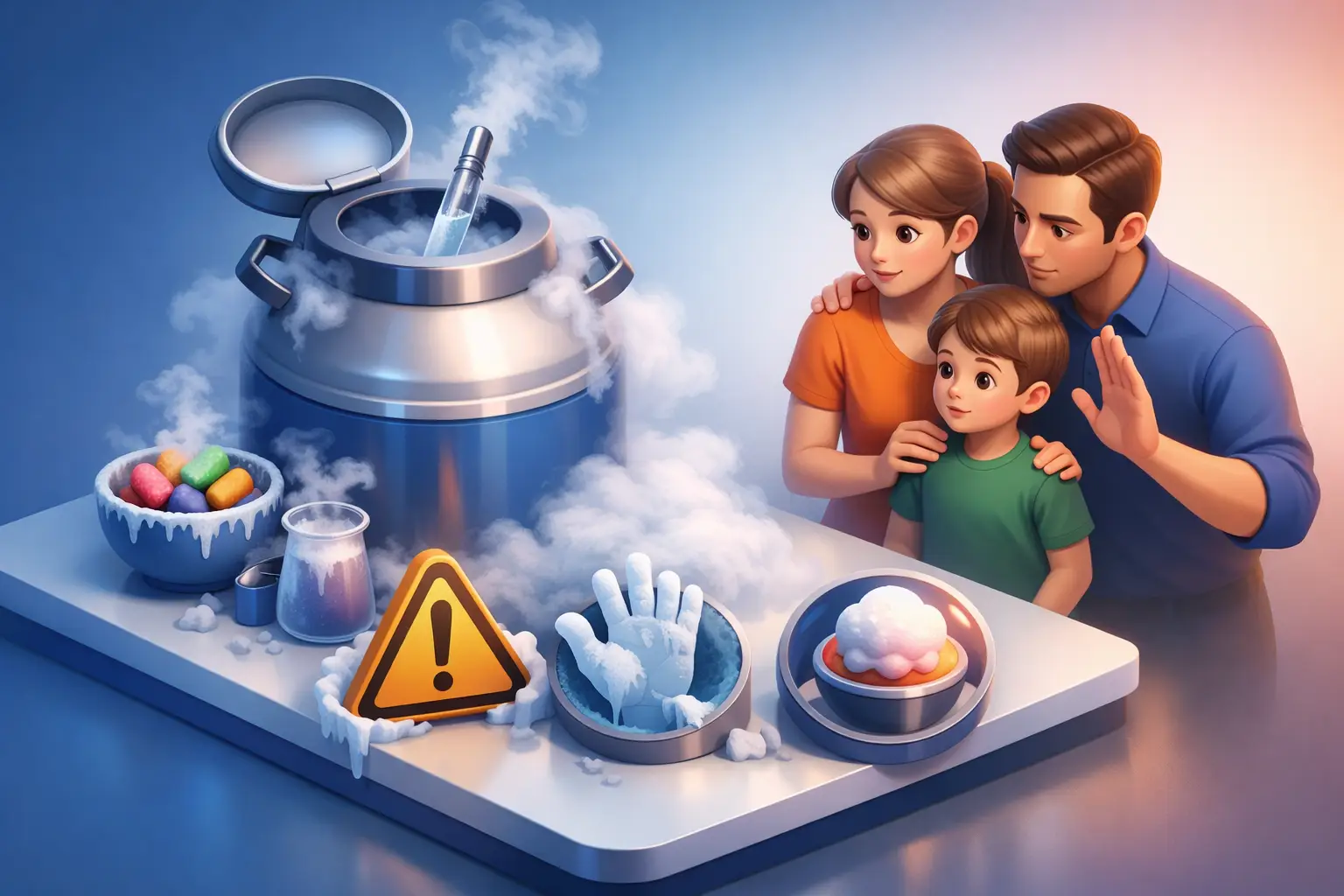
A metal container hisses, white fog spills across a table, and a child sees something that looks like a magic trick. Sıvı nitrojen, the Turkish term for liquid nitrogen, can create memorable science demonstrations. But its dramatic appearance can hide a simple fact: this is an extremely cold substance that demands adult knowledge, appropriate equipment, and firm boundaries.
For parents raising curious children, especially children who learn best through hands-on experiences, science demonstrations can be powerful. The goal is not to make science feel scary. It is to help children understand that real scientific curiosity includes preparation, observation, and respect for materials that can cause harm when handled casually.
What makes sıvı nitrojen different?
Liquid nitrogen is nitrogen gas cooled to about minus 320 degrees Fahrenheit. Nitrogen makes up most of the air around us, but in liquid form it behaves very differently. It boils rapidly at room temperature and changes back into gas almost immediately.
That boiling action creates the rolling white cloud people associate with demonstrations. The cloud itself is mostly condensed water vapor from the surrounding air, not visible nitrogen gas. The effect may look gentle, but the temperature is severe enough to damage skin and many common materials in seconds.
There is another risk that is less obvious. A small amount of liquid nitrogen expands into a much larger volume of gas as it warms. In an enclosed or poorly ventilated area, that gas can reduce the available oxygen. This is why responsible demonstrations are planned around open, ventilated spaces and never around sealed containers.
For families, the key lesson is straightforward: liquid nitrogen is not simply cold. It is a cryogenic material with behavior that must be understood before it is brought into a learning environment.
Where children may encounter liquid nitrogen
Most children will not encounter liquid nitrogen during an ordinary school day. When they do, it is usually through a supervised science event, a university outreach program, a food demonstration, or an adult-led activity involving freezing or special effects.
The most common point of confusion is the viral video. A short clip may show someone making instant frozen snacks, shattering a flower, or producing a fog effect. What the video often leaves out is the preparation: trained adult handling, specialized containers, eye protection, ventilation, and a controlled setting.
Children with attention differences, sensory sensitivities, or a strong impulse to touch and explore may need extra preparation before observing a demonstration. That is not a reason to exclude them. It is a reason to give them a clear preview: what they will see, what sounds they may hear, where they will stand, and which objects are for adults only.
A child who knows the rules ahead of time is more able to focus on the interesting science rather than managing surprise or uncertainty in the moment.
Practical rules for any liquid nitrogen demonstration
A well-run demonstration is quiet, deliberate, and free from improvisation. If an adult cannot explain the setup and boundaries clearly, the activity should wait.
Use the right container and space
Liquid nitrogen should be stored and transported only in purpose-built, vented containers designed for cryogenic materials. A sealed bottle, jar, or other closed vessel is never appropriate. As the liquid turns into gas, pressure can build rapidly and create a dangerous rupture.
The demonstration area should have strong ventilation and enough room for observers to stand back. A crowded kitchen, a bedroom, a car, a basement, or a small classroom corner is not the setting for this material. The more confined the space, the harder it is to manage gas buildup and accidental contact.
Adults should also keep the container stable on a level surface. A child, pet, backpack, loose sleeve, or trailing cable should never be able to bump it.
Set boundaries before the container opens
The most effective rule is simple: children observe from a designated distance while one prepared adult handles the material. Do not rely on repeated reminders after the container has started hissing or producing fog. Establish the boundary first.
For younger children, use concrete language. You might say, This is for looking, not touching. We keep both hands behind the line. We ask before moving closer. For older children, explain the reason: extreme cold can injure skin, and the gas needs room to spread into the air.
Adults should wear appropriate eye protection, insulated cryogenic gloves intended for this use, long sleeves, long pants, and closed-toe shoes. Ordinary kitchen gloves are not a substitute. A child should not be asked to pour, carry, or hold a container simply to make the activity more exciting.
Be especially careful with food demonstrations
Flash-frozen desserts are popular because the effect is visually striking. Yet food is one of the easiest ways to create false confidence. A snack can appear ready while tiny pockets of liquid nitrogen remain trapped in a spoon, cup, fruit piece, or mixture.
If liquid nitrogen is used around food, only the adult leading the activity should decide when it has fully evaporated. No one should taste, touch, or serve the food while fog is still coming off it. Do not pour liquid nitrogen directly into a child’s cup or hand, and do not use it to create a dramatic eating challenge.
For most family learning moments, a school or museum demonstration is a better choice than recreating a social media experiment at home. Children still get the wonder, while the environment has clearer procedures and more experienced supervision.
If contact or a spill happens
Speed matters, but panic does not help. Keep children away from the area and follow the facility’s emergency procedure if the demonstration is taking place at a school, camp, museum, or event.
For direct skin or eye contact, seek urgent emergency assistance. Do not rub the affected area, and do not try to pull away clothing that appears frozen to skin. If a spill occurs in a confined space, move people to fresh air and contact emergency services. A responsible adult should be prepared for these possibilities before any container is opened, not afterward.
This preparation is not excessive. It is what turns a risky-looking spectacle into a structured educational observation.
Questions to ask before your child participates
Parents do not need advanced chemistry knowledge to make a thoughtful decision. A few practical questions reveal whether an activity has been planned responsibly.
Ask who will handle the liquid nitrogen, where the demonstration will take place, how far children will stand from the container, and whether the room has adequate ventilation. If food is involved, ask who is responsible for confirming that the material has fully evaporated before anyone eats it.
It is also reasonable to ask how the instructor will prepare children who are sensitive to loud sounds, unexpected fog, or changes in routine. A brief explanation and a clear observation spot can make a major difference for a child who otherwise feels overwhelmed.
If the answers are vague, rushed, or focused mainly on the visual effect, choose not to participate. There will be other ways to explore states of matter, temperature, and gas expansion without putting a child in an uncomfortable situation.
Turn the spectacle into real learning
The best part of a liquid nitrogen demonstration often happens after the fog fades. Ask your child what they noticed first: the sound, the cloud, the speed of evaporation, or the way an object changed after cooling. Then connect those observations to bigger ideas about solids, liquids, gases, temperature, and change.
For children who benefit from structure, invite them to draw a before-and-after picture, make a prediction before the demonstration, or write three observations afterward. For children who enjoy numbers, discuss why a liquid becoming gas takes up much more space. For children who prefer visual learning, a simple diagram can help separate what they saw from what was actually happening.
Scientific confidence is not built by touching every exciting object. It grows when a child learns to observe carefully, ask strong questions, and recognize that responsible boundaries are part of how scientists work. That is a lesson worth carrying into every experiment they meet.