


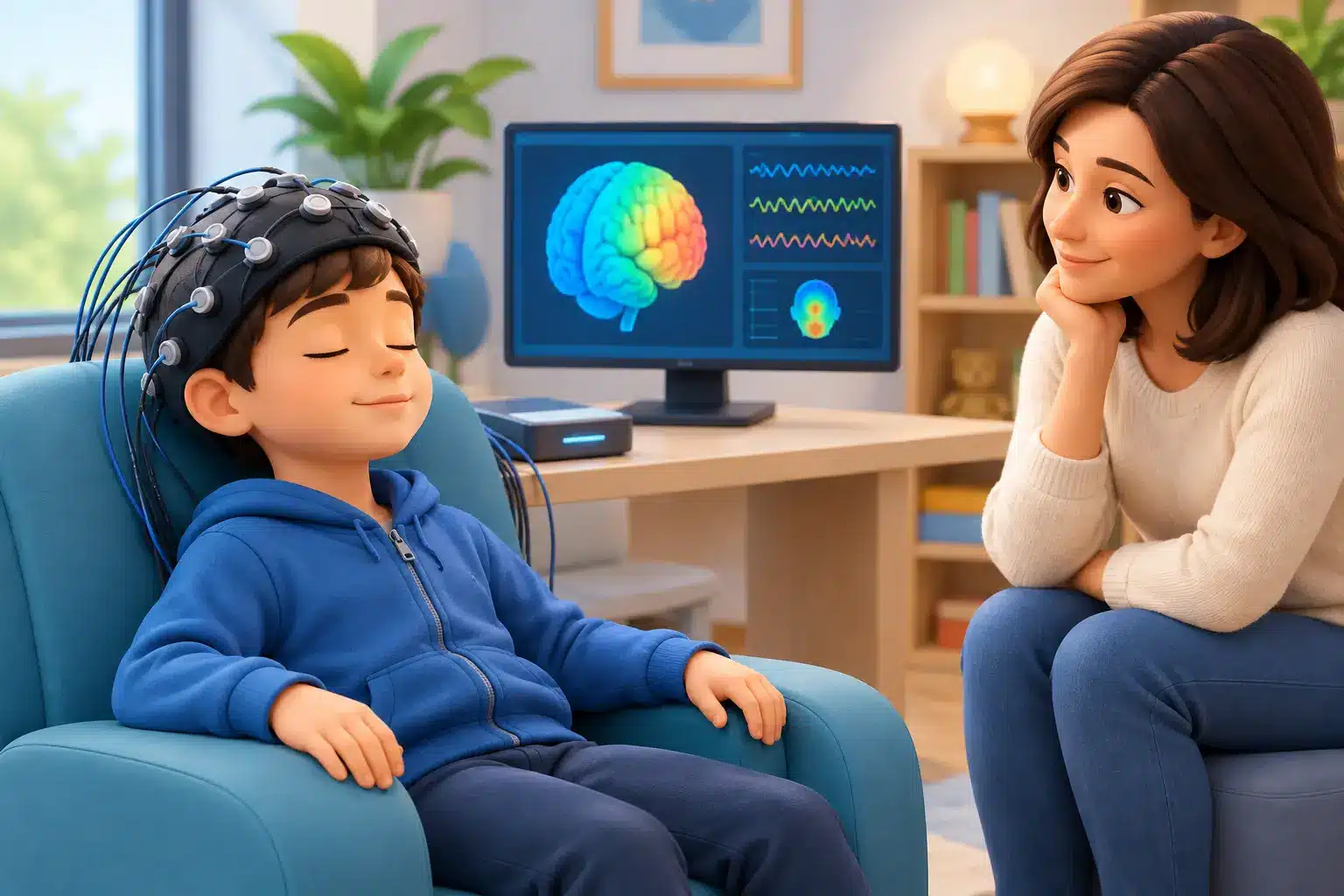
A child can know the answer, want to focus, and still lose the thread halfway through a worksheet. For many families, that gap between effort and consistency leads to a practical question: nörofeedback nedir, and could it fit alongside the educational supports their child already uses? Nörofeedback is an EEG-guided brain-training wellness practice that gives the brain real-time feedback about its own activity.
The central idea is simple: brains learn from feedback. When a child receives a visual or sound-based signal connected to a chosen brain activity pattern, they can gradually practice recognizing and repeating that pattern. It is not about asking a child to “try harder.” It is about creating a structured learning loop that can make attention practice more concrete, engaging, and measurable.
Nörofeedback nedir and how does it work?
Nörofeedback uses EEG sensors placed on the scalp to record tiny electrical signals associated with brain activity. The sensors do not read thoughts, judge intelligence, or send energy into the brain. They collect information, and software turns that information into immediate feedback – often through a game-like animation, video, sound, or other on-screen experience.
A session begins with a trained professional or guided platform setting up the sensors and selecting a protocol based on the child’s goals and baseline information. If the system detects the activity being practiced, the feedback responds right away: an animation may move more smoothly, a character may progress, or a sound may become clearer. When the selected pattern is not present, the feedback may pause or become less engaging.
Over repeated practice, the child’s brain has opportunities to learn from that moment-by-moment response. This is often described through neuroplasticity, the brain’s capacity to adapt through experience and repetition. The child does not need to consciously understand every EEG pattern for the learning loop to take place, much as they do not need to explain balance mechanics before learning to ride a bike.
For parents, the most useful distinction is this: neurofeedback is a practice process, not a one-time assessment and not a shortcut around sleep, routines, learning accommodations, or supportive relationships.
Why families explore brain-training wellness practices
Families commonly explore neurofeedback when everyday tasks require more effort than they seem to require for peers. A child may struggle to stay with reading, shift quickly between tasks, become frustrated during homework, or find it difficult to settle into a learning routine. These experiences can occur in children with ADHD, dyslexia, learning differences, autism spectrum differences, or no formal label at all.
Parents are often looking for a way to support skills such as sustained attention, regulation, learning readiness, or consistency during schoolwork. The appeal of EEG-guided feedback is that it is personalized to real-time signals rather than relying only on a parent’s observations or a child’s self-report.
That does not mean every goal is best served by the same protocol or that every child will engage with the format in the same way. A child who enjoys visual games may respond differently from one who finds sensors distracting. Age, sensory preferences, schedule, sleep habits, school demands, and the quality of the program all matter.
Research into neurofeedback continues to develop, with promising areas and meaningful variation across study designs, protocols, and participant groups. For a family, this calls for curiosity rather than sweeping promises. Ask what is being measured, why that metric is relevant to your child’s goal, and how progress will be reviewed over time.
What a child’s session may look like
A well-designed session should feel understandable, not intimidating. After the equipment is placed and the child is comfortable, they may watch a display, listen to audio, or interact with a simple activity while the system provides feedback. Younger children often do best when the experience is short, predictable, and framed as practice rather than a test.
Consistency usually matters more than intensity. A realistic routine that a family can maintain is generally more useful than an ambitious plan that creates stress. Some children need time to become familiar with the equipment before they can fully engage. Others become comfortable quickly but need more repetition before parents notice changes in daily routines.
Progress tracking should extend beyond the screen. Families can observe whether homework starts with less resistance, whether transitions feel more manageable, whether reading practice lasts longer, or whether a child can return to a task after distraction. These observations are not proof by themselves, but they can help connect practice goals with daily life.
It also helps to define one or two priorities before beginning. “Better focus” is broad. “Stay with independent reading for 10 minutes with fewer reminders” is easier to observe and discuss. Clear goals protect families from chasing vague improvement and make later decisions more grounded.
Questions worth asking before you begin
The quality of guidance matters as much as the technology. Before choosing a neurofeedback program, parents should ask how the child’s starting point is established, how sessions are adapted, and how the team communicates when a child is tired, disengaged, or overwhelmed.
It is also reasonable to ask what kind of feedback the child will see, how often practice is suggested, and how the program tracks change. A provider should be able to explain the process in plain language without making outcomes sound automatic.
Consider these practical questions:
- What specific learning or regulation goal are we practicing?
- How will progress be tracked at home and at school?
- What does the session look like for a child of my child’s age?
- How can the plan be adjusted if engagement is low?
- How does this practice fit with our existing educational supports and family routine?
For children with learning differences, coordination matters. A brain-training wellness practice may sit alongside tutoring, school accommodations, speech and language support, counseling, movement, and family routines. It should not be presented as a replacement for individualized guidance from the professionals already supporting your child.
What neurofeedback cannot tell you
EEG feedback can provide useful information for a structured practice experience, but it cannot capture the whole child. It does not explain a difficult day at school, replace a conversation with a teacher, or account for every influence on attention and behavior. Hunger, social stress, poor sleep, a new classroom expectation, and developmental changes can all affect how a child shows up.
It also cannot promise a particular academic or behavioral outcome. Some families notice meaningful changes in routines or engagement, while others may decide the approach is not the right fit. Individual results may vary.
Parents should be especially cautious with language that makes a child sound broken or frames neurofeedback as a way to erase who they are. The purpose of thoughtful support is not to make a child more convenient for adults. It is to help them access learning, confidence, and participation in ways that respect their individual profile.
This educational wellness information does not replace advice from your physician. If you have concerns about your child’s development, learning, sleep, behavior, or overall well-being, a qualified professional who knows your child can help you consider the appropriate next steps.
A more useful way to decide
Rather than asking whether neurofeedback is “the answer,” consider whether it is a practice your child can participate in consistently and whether its goals match the challenges your family is trying to address. The strongest decision is usually not driven by a dramatic promise. It comes from clear questions, realistic expectations, and a willingness to observe what helps your child feel more capable over time.
At Auto Train Brain, that parent-centered perspective matters: measurable practice should always serve the child, not the other way around. A thoughtful introductory conversation can help you decide whether EEG-guided brain training belongs in your family’s broader educational support plan.