


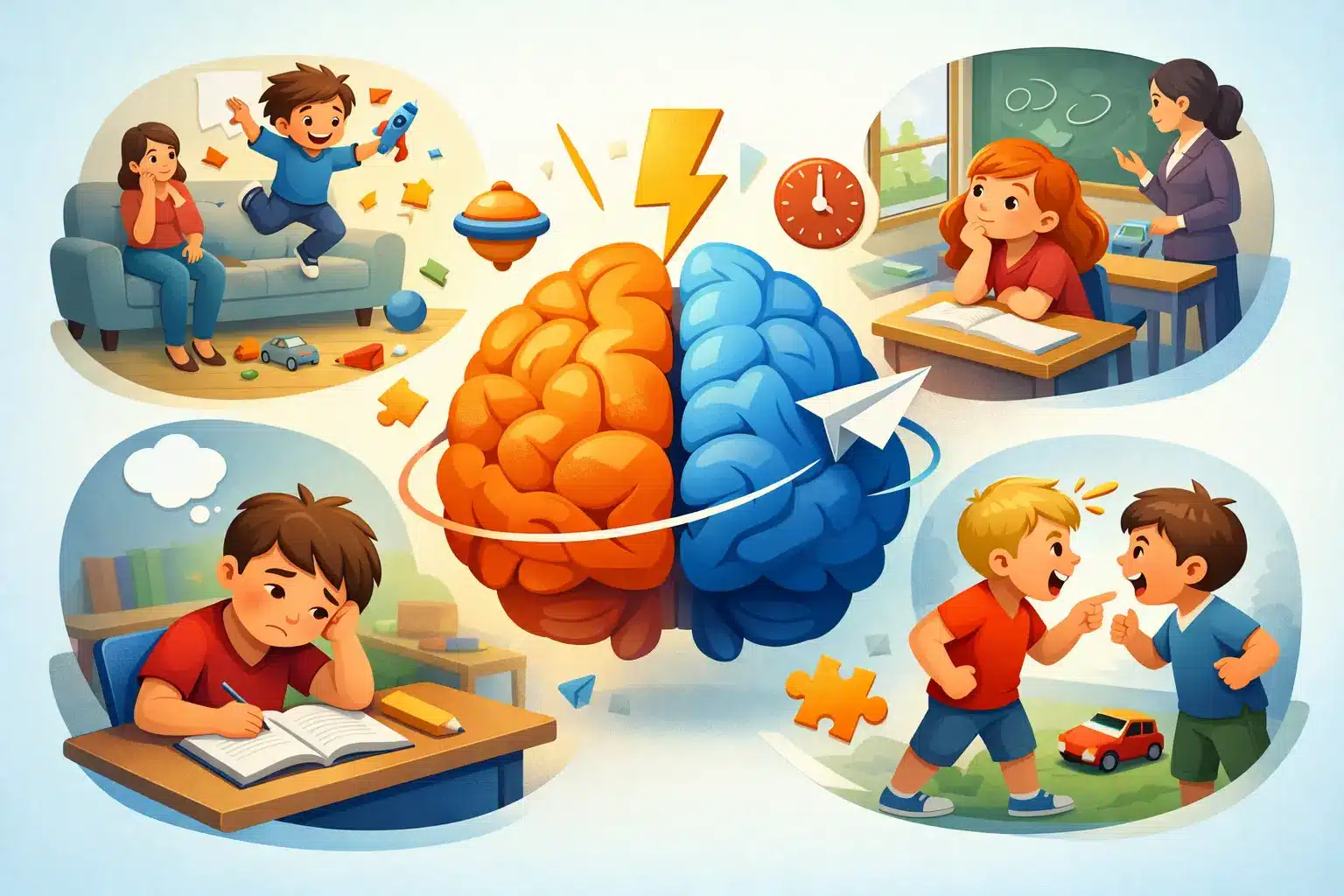
A child who abandons a worksheet halfway through, talks over every family conversation, or melts down when it is time to leave the playground is not necessarily being defiant. For many families, the harder question is whether these are ordinary growing pains or a pattern worth understanding. ADHD symptoms in children can show up differently from one child to the next, and noticing the full context matters more than labeling a single difficult afternoon.
Attention, activity level, and impulse control all develop over time. Children also have hungry days, overtired days, anxious days, and days when a noisy classroom makes every expectation harder. What tends to get a parent’s attention is a pattern that is frequent, intense, and disruptive across everyday routines – especially when a child is trying hard but still struggling.
What ADHD symptoms in children can look like
ADHD is commonly associated with differences in attention, hyperactivity, and impulsivity. A child does not need to look constantly energetic for attention-related challenges to be present. Some children are outwardly busy and quick to act. Others appear quiet, dreamy, or absorbed in their own thoughts, while missing directions and losing track of tasks.
Attention can be inconsistent, not absent
A child may focus deeply on building sets, video games, drawing, or a favorite topic, then find a short multistep direction almost impossible to hold onto. This inconsistency can confuse adults: “If they can focus on that, why can’t they focus on homework?”
The difference often lies in the task. Preferred activities may provide immediate interest and feedback. Homework, organizing a backpack, or copying notes may require planning, working memory, and sustained effort before there is any reward. You might notice frequent forgotten instructions, unfinished work, misplaced items, avoidable mistakes, or a child who seems not to hear you until you repeat a request several times.
High activity may show up in more than movement
For some children, high activity is easy to see. They may run, climb, fidget, leave their seat, or talk almost continuously. For others, it is more subtle: tapping a foot, picking at clothing, humming, changing positions often, or seeming unable to settle during a meal or story.
Activity level should always be viewed through age and setting. A preschooler who wants to move is behaving like a preschooler. The concern is not that a child has energy. It is whether movement regularly makes schoolwork, play, meals, sleep routines, or family transitions much harder than they need to be.
Impulsivity can affect words, choices, and emotions
Impulsivity is not simply “acting naughty.” It can look like answering before a question is finished, interrupting, grabbing an item, rushing through work, or taking a physical risk without pausing to consider the outcome. Children may feel genuinely sorry afterward because the pause between urge and action is difficult to access in the moment.
Big reactions can also accompany impulsivity. A small disappointment may lead to tears, shouting, or a sudden exit from an activity. That does not mean every emotional reaction points to ADHD. It does mean that the child may benefit from adults who focus on the skill underneath the moment: pausing, naming the feeling, asking for help, and trying again.
The pattern matters more than one behavior
Many ADHD-like behaviors overlap with other experiences. Poor sleep, hearing or vision concerns, a learning difference, anxiety, grief, hunger, sensory overload, bullying, and a classroom mismatch can all affect concentration and behavior. That is why online checklists can be a useful starting point for observation, but not a final answer.
Look for patterns across time and settings. Does your child struggle mainly after school, when they have used up their energy holding it together all day? Is the challenge strongest during reading, writing, or math? Do they have fewer difficulties in a small group than in a busy classroom? These details do not just describe a problem. They point toward the support a child may need.
Age also changes how symptoms appear. Younger children may have trouble waiting, shifting between activities, or following simple routines. Elementary-aged children may lose materials, rush assignments, or need repeated reminders. Teens may struggle more with deadlines, planning, driving-related judgment, emotional regulation, or the growing independence expected of them. A child’s strengths and environment shape the picture at every stage.
How to turn worry into useful information
When you are concerned, try not to rely only on memory after a hard day. A brief record over two or three weeks can make conversations with school staff and a qualified professional much clearer. Keep it factual and specific rather than interpretive.
Note what happened, where it happened, what came just before it, how long it lasted, and what helped the child recover or re-engage. For example, “Left the table three times during a 15-minute worksheet after a noisy school day; completed two questions after a snack and one-step directions” is more useful than “Couldn’t focus again.”
Ask teachers what they see during independent work, group instruction, transitions, recess, and tests. Their view may differ from yours, and that difference is valuable. A child who finds home routines difficult but manages school may be using enormous effort during the day. A child who struggles mostly in one subject may need academic support targeted to that task.
If patterns are affecting learning, relationships, confidence, or daily functioning, speak with your child’s physician or another qualified professional who can guide the next steps. In the United States, families can also ask their school about available supports and an evaluation for educational needs. You do not have to wait until a child is failing to begin a thoughtful conversation.
Small supports can reduce daily friction
Support is most effective when it fits the child rather than demanding that the child fit a rigid system. One child may need a visual checklist by the door. Another may need instructions given one step at a time, with a quick repeat-back: “What are you doing first?” A teen may need a shared planning routine rather than another reminder to “be more organized.”
At home, aim for fewer verbal reminders and more visible structure. Keep morning essentials in one consistent place, break larger tasks into short starts, and build movement into transitions. A five-minute reset before homework may be more productive than insisting on immediate stillness after a long school day.
At school, seating, written directions, extra time to organize materials, movement opportunities, and chunked assignments may help some children participate more fully. The right approach depends on the child, the classroom, and the task. What matters is tracking whether a support reduces friction without making the child feel singled out.
A brain-training wellness practice centered on neurofeedback may also be one educational option families explore alongside established school and professional guidance. Auto Train Brain is designed around measurable practice and real-time feedback, with the goal of supporting attention-related skills through a consistent routine. It is not a replacement for individualized guidance or school-based support.
Protect your child’s confidence while you seek answers
Children often hear correction long before adults recognize how much effort they are already using. “You are not listening,” “You are lazy,” or “Why can’t you just sit still?” can become a painful story a child tells about themselves. Replace character judgments with clear observations and a path forward: “Your body has a lot of energy right now. Let’s take a movement break, then start the first problem together.”
Notice strengths with the same care you bring to challenges. Many children who struggle with attention or impulse control are imaginative, funny, observant, passionate, energetic, or deeply persistent when something matters to them. These qualities do not erase the hard parts, but they belong in the picture.
You do not need to solve every question this week. Start by observing with compassion, gathering specific examples, and choosing one routine that can feel easier for your child. A calmer morning, a more successful homework start, or one less shame-filled conversation can create meaningful room for growth.
Not a medical device – does not replace physician advice. Individual results may vary.