


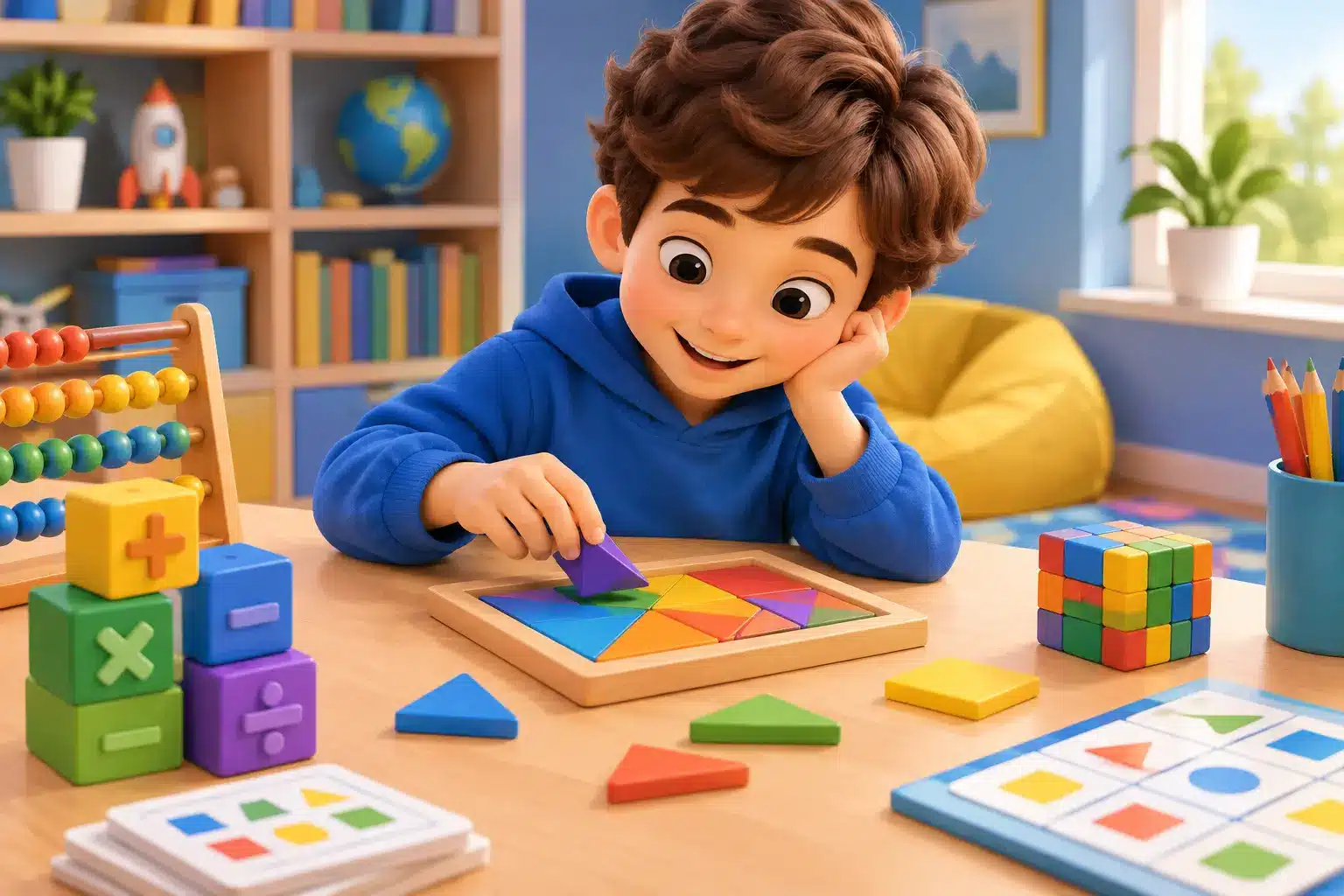
A child who freezes at a worksheet may spend 20 focused minutes trying to beat a parent at a dice game. The math skill has not suddenly become easier. What changed is the experience around it: less pressure, a clearer goal, and more chances to try again without feeling judged. For parents searching for matematik oyunları çocuk, that distinction matters.
Math games are not a shortcut around learning. Used thoughtfully, they can give children more repetitions with numbers, patterns, sequencing, and problem-solving while protecting something equally valuable: their willingness to stay engaged. This can be especially meaningful for children with attention differences, learning challenges, dyslexia, or a history of believing they are simply “bad at math.”
Why math feels harder when pressure takes over
A math task can ask for several skills at once. A child may need to hold directions in mind, track symbols, remember a number fact, manage frustration, and write an answer before time runs out. If attention or working memory is already under strain, even a simple page can feel overwhelming.
Games reduce the number of things that feel at stake. Instead of facing a column of problems, the child rolls, matches, builds, moves, predicts, or chooses. Feedback arrives quickly: the card matches or it does not; the total wins the round or it does not. That immediate loop can help a child notice patterns and adjust their approach in the next turn.
The goal is not to disguise every lesson as entertainment. Children still need direct instruction and practice when a new idea is being introduced. But games can make the practice phase more active and less emotionally loaded. It depends on the child, the skill being practiced, and whether the game is simple enough to play without constant adult correction.
Matematik oyunları çocuk development can grow with
The most useful games are not necessarily the ones with the brightest graphics or the longest rulebook. They are the ones that target one clear skill and allow the child to make meaningful choices. Start with the skill your child is already approaching, rather than the one that creates the most resistance.
For number sense: use real objects and quick comparisons
Number sense is the ability to understand what numbers represent, not merely recite them. For younger children, place two small groups of buttons, blocks, or coins on a table and ask, “Which group has more?” Then invite them to explain how they know.
A simple “make 10” game is another strong option. Put number cards from 0 to 10 face down. Each player turns over two cards and keeps the pair if they add up to 10. This turns a foundational fact family into a repeated, hands-on pattern. If 10 is too challenging, begin with 5. If it is too easy, move to totals of 20.
For children who benefit from movement, write numbers on paper plates and place them around the room. Call out a number combination, such as “4 plus 3,” and have the child step onto 7. The physical action gives some children an extra cue for staying with the task.
For attention and working memory: keep turns short
Long games can lose a child before the learning has a chance to happen. Choose rounds that last five to ten minutes, especially when attention is variable. A short game that ends with a child wanting one more round is more useful than a 30-minute activity that ends in frustration.
Try a sequence game with cards or household items. Show three items in an order, cover them, and ask your child to recreate the sequence. Add one item only when the current level feels manageable. You can also play “what changed?” by arranging five objects, asking your child to look closely, then switching two objects while they close their eyes.
These are not strictly arithmetic games, but they support skills children often use during math: noticing details, holding information briefly, and following an ordered process. Keep the language encouraging and specific. “You remembered the whole order” is more helpful than a general “good job.”
For addition and subtraction: make strategy visible
Many children memorize facts unevenly. They may know 2 plus 2 but hesitate when they see 7 plus 6. A game can help them practice a strategy without turning every pause into a correction.
Use two dice and ask each player to find the total in their own way. One child may count every dot. Another may recognize 6 and add 4 more. A third may know that 6 plus 6 is 12 and add one. Let them explain their thinking after the round, but avoid insisting that everyone use the same method.
For subtraction, start with a small pile of counters. Say, “There are 12 stars. The spaceship takes away 5. How many are left?” Let the child move the objects rather than solve only in their head. Concrete materials are not a crutch. They are a bridge between an abstract symbol and a quantity a child can see.
For older children: bring math into decisions
Children in later elementary and middle school often reject activities they consider too childish. The answer is not to stop playing, but to use challenges that feel more relevant.
Ask your child to plan a snack budget, compare unit prices in a pretend store, calculate a sports score scenario, or design a room using a scale drawing. Card games involving probability and strategy can also create natural conversations about odds, percentages, and planning ahead.
The key is authenticity. If your child loves fashion, compare discounts. If they enjoy gaming, discuss resources, upgrades, or probability in a game-like scenario. If they care about animals, build a feeding schedule with fractions. Interest does not replace practice, but it can provide a reason to persist through it.
How to choose a game without creating another battle
Before bringing out a new activity, ask one practical question: what is the smallest skill I want my child to rehearse? It might be recognizing quantities to 10, counting by fives, comparing fractions, or staying with a two-step direction. A game that tries to practice everything often practices nothing well.
Then watch the ratio of challenge to success. If your child wins every time, increase the complexity gently. If they lose repeatedly, simplify the rules, shorten the round, or become a teammate instead of an opponent. Competition motivates some children and shuts others down. Cooperative games, where parent and child work together toward a shared score, can be a better fit when confidence is low.
Also consider sensory needs. Some children concentrate better with tactile pieces and a quiet table. Others do better standing up, tossing a beanbag, or moving between stations. A digital game may be useful when it is purposeful and time-limited, but it should not be the only format. Physical materials provide information that a screen cannot always offer: size, grouping, movement, and touch.
The parent’s role: guide, do not take over
It is tempting to jump in the moment a child hesitates. Yet the pause is often where learning begins. Try waiting a few seconds, then use a prompt that narrows the task without giving away the answer: “What do you notice?” “Can you make a group of five first?” “Which number is larger?”
When mistakes happen, treat them as information. Instead of saying, “No, that is wrong,” try, “Let’s check that with the counters,” or “Show me how you got there.” This keeps the focus on the strategy rather than the child’s identity. Over time, a child may become more willing to attempt a problem before asking for help.
A consistent routine helps, too. Ten minutes after school, two rounds after dinner, or a weekend family game can be enough. The best schedule is one your family can repeat without turning it into another obligation. If your child is tired, dysregulated, or already overwhelmed, connection may be more valuable than practice that day.
Math games work best when they communicate a quiet message: numbers are something you can explore, not a test of whether you are smart. Build from your child’s current abilities, notice effort as well as answers, and let small moments of curiosity lead the way.
This educational wellness resource does not replace physician advice. Individual results may vary.