


You walk into the kitchen for one thing, notice an email on your phone, and return to your desk without the item you meant to get. Moments like this are familiar, especially during packed workweeks. Memory games for adults offer something more useful than a high score: a short, intentional way to practice focus, recall, and mental flexibility without adding another demanding obligation to your day.
The best game is not necessarily the hardest one or the one with the flashiest app design. It is the one you can return to often enough to notice your own patterns. For adults balancing work, family responsibilities, sleep changes, appointments, and nonstop notifications, consistency matters more than an occasional marathon session.
What Memory Games for Adults Can Practice
Memory is not a single skill. Remembering a coworker’s name, holding a short set of instructions in mind, recalling where you parked, and learning a new route all draw on somewhat different processes. That is why a varied game routine is usually more engaging than repeating one format until it becomes automatic.
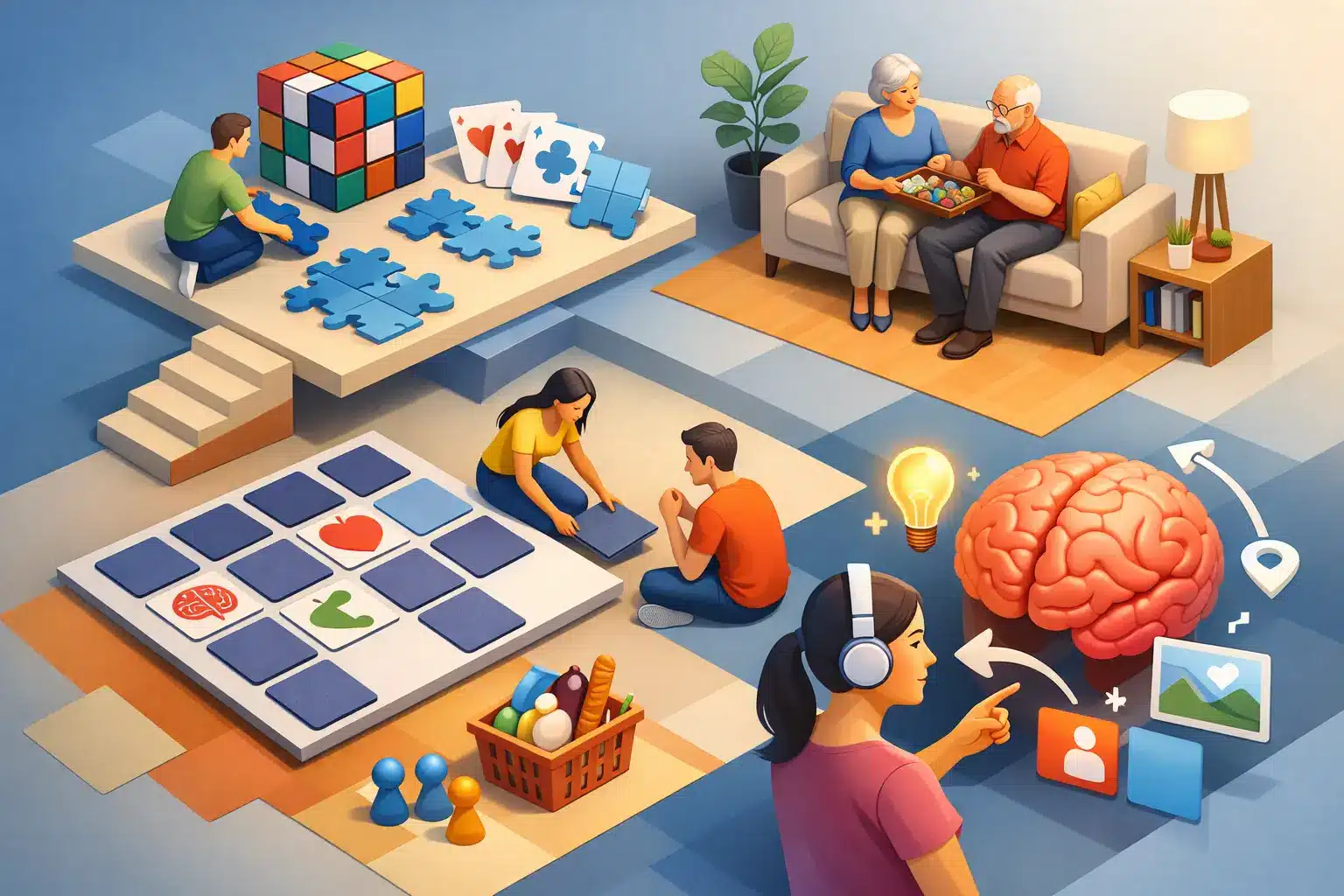
Working-memory games ask you to briefly hold and update information. A simple example is hearing a sequence of numbers and repeating it backward. Visual recall games may show a group of objects, colors, or locations for a few seconds before asking what changed. Association games encourage you to connect unfamiliar information to a vivid image, story, or category. Strategy games add planning, pattern recognition, and the need to revise your next move.
Each format gives your attention a slightly different job. If a word game feels effortless but a visual pattern game feels demanding, that does not mean one ability is “better” than another. It simply gives you a useful clue about which kinds of information require more deliberate attention right now.
There is an important trade-off here. Repeated practice often helps people get better at the exact activity they practice. Whether a game changes every part of daily memory is less certain and depends on the person, the game, and what else is happening in their routine. Treat games as a brain-training wellness practice, not a shortcut or a scorecard for your overall ability.
Choose Games That Create the Right Kind of Challenge
A good memory game should feel effortful without becoming frustrating. If you solve every round while half-watching television, the task may be too easy to hold your attention. If you repeatedly miss the first step and feel discouraged, it may be too difficult to sustain. The useful middle ground is a challenge you can complete with concentration, then gradually increase.
For a busy adult, the game format matters as much as the content. A five-minute visual matching exercise can fit between meetings. A deck of cards can become a screen-free evening ritual. Learning a short poem, recipe, or set of song lyrics from memory may suit someone who enjoys language more than abstract patterns. A strategy board game may work better for people who want a social activity rather than solo screen time.
Try to choose games with a clear feedback loop. You should be able to see what you remembered, where you lost track, and what strategy helped. For instance, when remembering a grocery list, grouping items by aisle may work better than repeating the entire list word for word. When recalling names, linking a name to a noticeable detail or a shared context can make the information easier to retrieve later.
The point is not to force yourself into a game you dislike. Enjoyment is practical. A puzzle you look forward to doing three times a week is likely to become part of your routine, while an impressive-looking challenge you avoid will not give you much opportunity for practice.
Four Formats Worth Rotating
Rotating formats can prevent your routine from becoming mechanical. Consider combining these four categories over the course of a week:
- Visual recall: Study a grid, a scene, or a group of objects, then recreate it after a short delay.
- Word and association games: Use word lists, categories, stories, names, or word-pair challenges.
- Number and sequence tasks: Repeat number sequences, track changing rules, or solve pattern-based puzzles.
- Strategy and spatial games: Play card, tile, logic, or board games that require planning several moves ahead.
You do not need an elaborate setup. A notebook, a deck of cards, a puzzle book, or a thoughtfully designed digital game can all work. What matters is whether the activity asks you to pay attention, retrieve information, and adapt your approach.
Build a Practice You Will Actually Keep
Adults often abandon memory routines for the same reason they abandon complicated fitness plans: the plan asks for too much too soon. Start with 10 minutes, three times a week. Attach it to a cue that already exists, such as your morning coffee, lunch break, or the first quiet minutes after dinner.
Keep a small record of your sessions, but do not obsess over scores. A simple note can capture the game, the level, how focused you felt, and one strategy you tried. Over a few weeks, this can reveal patterns that a single score cannot. Perhaps visual tasks feel easier in the morning, while word games are more enjoyable at night. Perhaps you do better when your phone is in another room. Those observations help you shape a routine around real life rather than ideal conditions.
Progression should be gradual. Add one item to a sequence, shorten the viewing time by a few seconds, or introduce a new rule after an existing level feels familiar. Constantly escalating difficulty is not required. Some sessions can be lighter and still serve a purpose by reinforcing the habit of focused attention.
It also helps to protect the conditions around the game. A rushed, noisy, interrupted session is not a failure, but it may make it harder to tell whether the task itself was challenging. Put notifications on pause when possible. Give yourself permission to do one round well rather than five rounds while distracted.
Make the Practice Useful Beyond the Game
The most satisfying routines create opportunities to use the same strategies in ordinary moments. After a visual recall game, try noticing five details when you enter a room and recalling them an hour later. After a name-association exercise, use the technique at your next meeting or community event. After a sequence task, practice remembering a short errand list before reaching for your phone.
This is not about turning every moment into homework. It is about recognizing that memory strategies work best when they are relevant. A visual learner may benefit from drawing a quick map or using color-coded notes. Someone who remembers stories may make a narrative out of a list. A person who enjoys movement might pair items to remember with places on a familiar walk through the house.
Social games deserve a place here, too. Playing cards, trivia, or a collaborative word game with a partner or friend adds conversation, laughter, and unexpected clues. The social element can make a routine more sustainable, particularly for adults who find solitary brain games repetitive.
When a Game Is Not the Whole Picture
Memory can feel different from one day to the next. Stress, poor sleep, overload, grief, major schedule changes, and constant multitasking can all affect how easily information stays in view. A difficult game session may reflect the day you had, not a fixed limit.
Be wary of programs that imply a leaderboard can define your mind. A higher score can be motivating, but it is not a complete measure of how you learn, create, connect, or manage daily life. Individual results may vary, and the most meaningful benchmark is often whether you are building a sustainable practice that feels purposeful.
If noticeable memory changes are sudden, worsening, or disrupting everyday responsibilities, a qualified health professional can help you consider the broader context. Games can remain an enjoyable part of your routine, but they should not carry the burden of explaining every change you notice.
A memory practice does not need to be dramatic to be worthwhile. Choose one game that makes you pause, focus fully for a few minutes, and try again tomorrow. That small appointment with your attention may become one of the most refreshing parts of your week.