


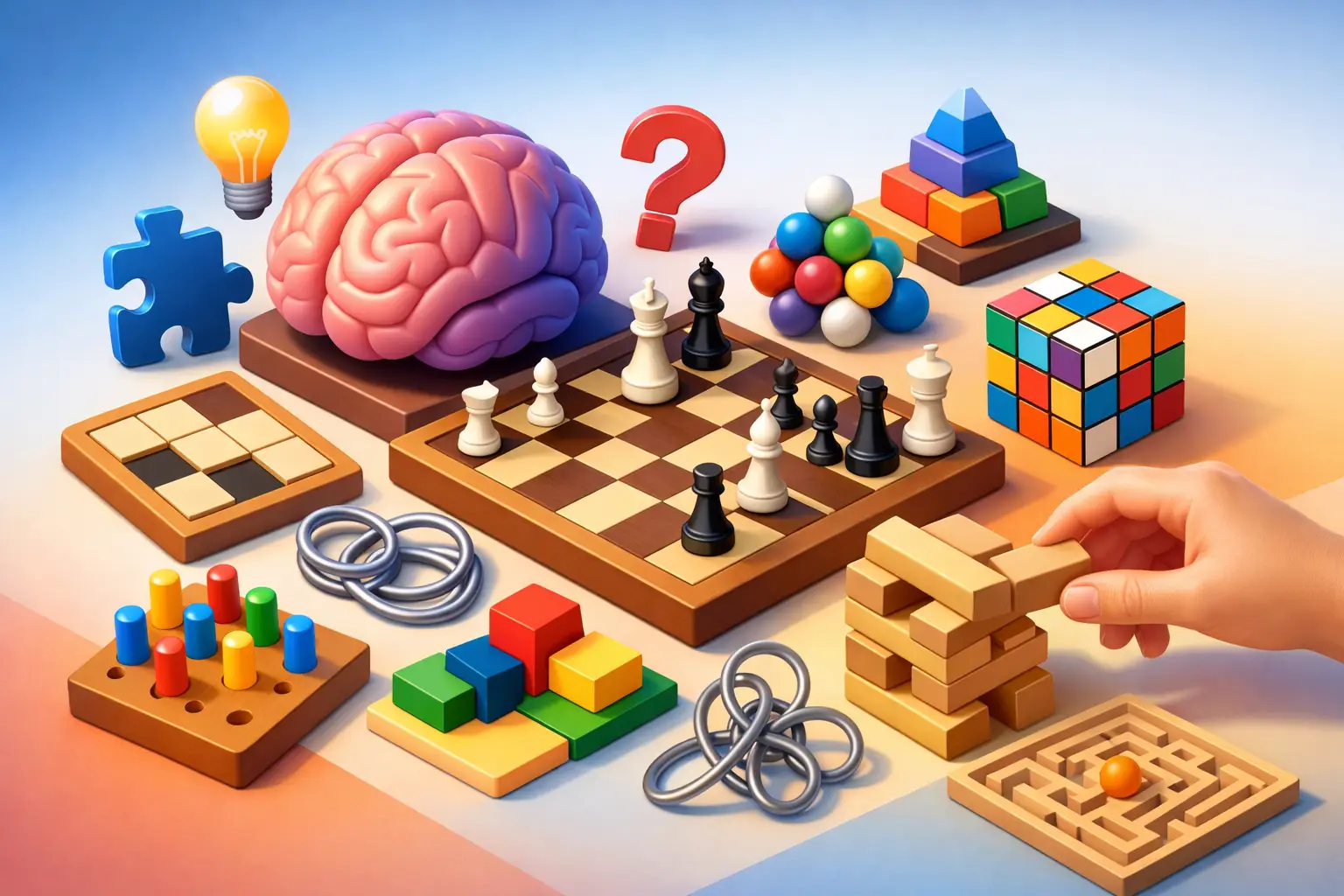
A puzzle that feels satisfying at 8:00 p.m. after a demanding day can feel impossible at 8:00 a.m. before your first coffee. That is why yetişkinler için zeka oyunları should not be chosen only by difficulty level or popularity. The right game needs to fit your attention, your energy, and the mental skill you actually want to practice.
For many adults, especially people balancing family responsibilities, work, stress, and a constantly buzzing phone, the goal is not to become a competitive puzzle solver. It is to create a small, repeatable moment of focused effort. A well-chosen game can offer a useful pause from passive scrolling while giving your mind a clear, engaging task.
What adult brain games can realistically offer
Brain games are often marketed as if one app or puzzle can transform every aspect of thinking. Real life is more nuanced. Practicing a particular kind of challenge can help you become more familiar with that challenge: word games can strengthen word-retrieval habits, logic puzzles can encourage structured reasoning, and strategy games can ask you to plan ahead under changing conditions.
The transfer from a game to every part of daily life is less predictable. Someone who gets faster at Sudoku may not automatically become better at managing a crowded schedule or remembering every item on a grocery list. Still, a regular mental practice can be valuable because it creates a deliberate space for attention, persistence, curiosity, and problem-solving.
Think of games as one part of a broader cognitive wellness routine. Sleep quality, movement, social connection, meaningful learning, stress load, and daily structure all shape how focused and mentally energized you feel. A game is not a shortcut around those foundations. It can be a practical addition to them.
Yetişkinler için zeka oyunları: Start with your goal
Before downloading an app or buying a new puzzle book, ask one simple question: What would I like this activity to feel like? Your answer matters more than whether a game is labeled “brain training.”
If you want a calm transition after work, a visual puzzle, jigsaw, or low-pressure matching game may work better than a timed arithmetic challenge. If you are trying to replace late-night social media, a crossword or daily word puzzle can provide a satisfying ritual without the endless feed. If you enjoy competition and quick feedback, a timed logic game may hold your attention more effectively.
Adults often abandon games not because they lack discipline, but because they picked a format that conflicts with their real life. A high-pressure game can be energizing for one person and exhausting for another. The best choice is the one you will return to without needing to negotiate with yourself every day.
For focus: Choose one-task games
When your attention feels scattered, look for games with a clear objective and limited visual clutter. Number-placement puzzles, pattern puzzles, spot-the-difference challenges, and short memory sequences can help create a contained focus session.
The key is to avoid turning the game into another source of alerts. Consider playing in airplane mode, silencing notifications, or using a paper-based option. Ten uninterrupted minutes usually offer more value than thirty minutes spent switching between a game, messages, and headlines.
For flexible thinking: Try strategy with changing rules
Some games ask you to revise your plan as new information appears. Card games, board games, tile-placement games, and turn-based strategy puzzles can be especially useful for adults who enjoy thinking a few moves ahead.
These formats are not always relaxing. They can create healthy friction, which is part of their appeal. But if you already make complex decisions all day, reserve them for times when you have enough mental bandwidth to enjoy the challenge rather than resent it.
For language and recall: Make words social
Crosswords, anagrams, word ladders, trivia, and category games are familiar for a reason: they are easy to start and easy to share. A word game with a spouse, friend, teenager, or colleague adds conversation to the activity, which may make the habit more enjoyable and easier to maintain.
Do not confuse speed with value. Taking time to reason through a clue, explaining your answer out loud, or looking up a topic afterward can be more engaging than racing through a daily puzzle just to protect a streak.
Build a routine that does not become another obligation
The most useful game is rarely the hardest one. It is the one that fits into the rhythm of your week. Start with a small commitment: perhaps ten minutes three times a week, or one puzzle after dinner on weekdays. Give the routine a clear cue, such as setting your puzzle book next to the kettle or opening a game only after you put your phone on its charger.
It also helps to rotate formats. Repeating one game can build comfort and skill, but eventually it may become automatic. Try alternating between a word-based challenge, a visual-spatial puzzle, and a strategy game. This keeps the experience fresh without forcing you to start from zero each time.
A simple rotation might include:
- A short word puzzle on busy weekdays
- A logic or number puzzle when you have quiet concentration
- A board or card game for weekends with family or friends
- A visual puzzle for evenings when words feel like too much work
This is not about filling every spare moment with self-improvement. Boredom and rest have a role too. If a game starts feeling like homework, pause it. Sustainable cognitive wellness should leave you feeling engaged, not judged.
How to spot a game that is worth your time
A quality game does not need dramatic promises. In fact, be cautious when an app claims it can fix every memory, attention, or productivity concern through a few minutes of play. Better signals are simpler: clear instructions, an adjustable level of challenge, a design that limits distractions, and feedback that helps you understand your choices.
Look for games that let you progress gradually. A challenge should be difficult enough to require effort, but not so difficult that you quit after two sessions. If you solve every puzzle immediately, raise the level or change formats. If you feel stuck repeatedly, step down for a while. Difficulty is not a badge of honor. It is a setting you can adjust.
Pay attention to the business model, too. Some free apps are designed around constant prompts, countdowns, and purchases. That may be fine if you genuinely enjoy them, but it can undermine the calm, focused break you were hoping to create. A paper puzzle book, a deck of cards, or a simple ad-light game can sometimes support a better habit.
Measure consistency, not just scores
Scores can be motivating, but they are not the whole story. A higher score may reflect familiarity with a game’s rules, a better night of sleep, or simply a less interrupted session. Instead of tracking every result, notice patterns over a few weeks.
Ask yourself whether you are showing up more consistently, whether the activity helps you shift out of work mode, and whether you are enjoying the process. You might also notice practical changes, such as being more willing to tackle a difficult task without immediately reaching for your phone. These observations are personal, not proof of a guaranteed outcome.
For adults interested in a more structured approach, a brain-training wellness practice such as EyeZenith can provide a dedicated format for building an intentional mental routine. The right approach still depends on your goals, schedule, and preferences.
Individual results may vary.
The best adult brain game is not the one that makes the biggest promise. It is the one that gives you a reason to pause, concentrate, and stay curious long enough for the practice to become part of your life.