


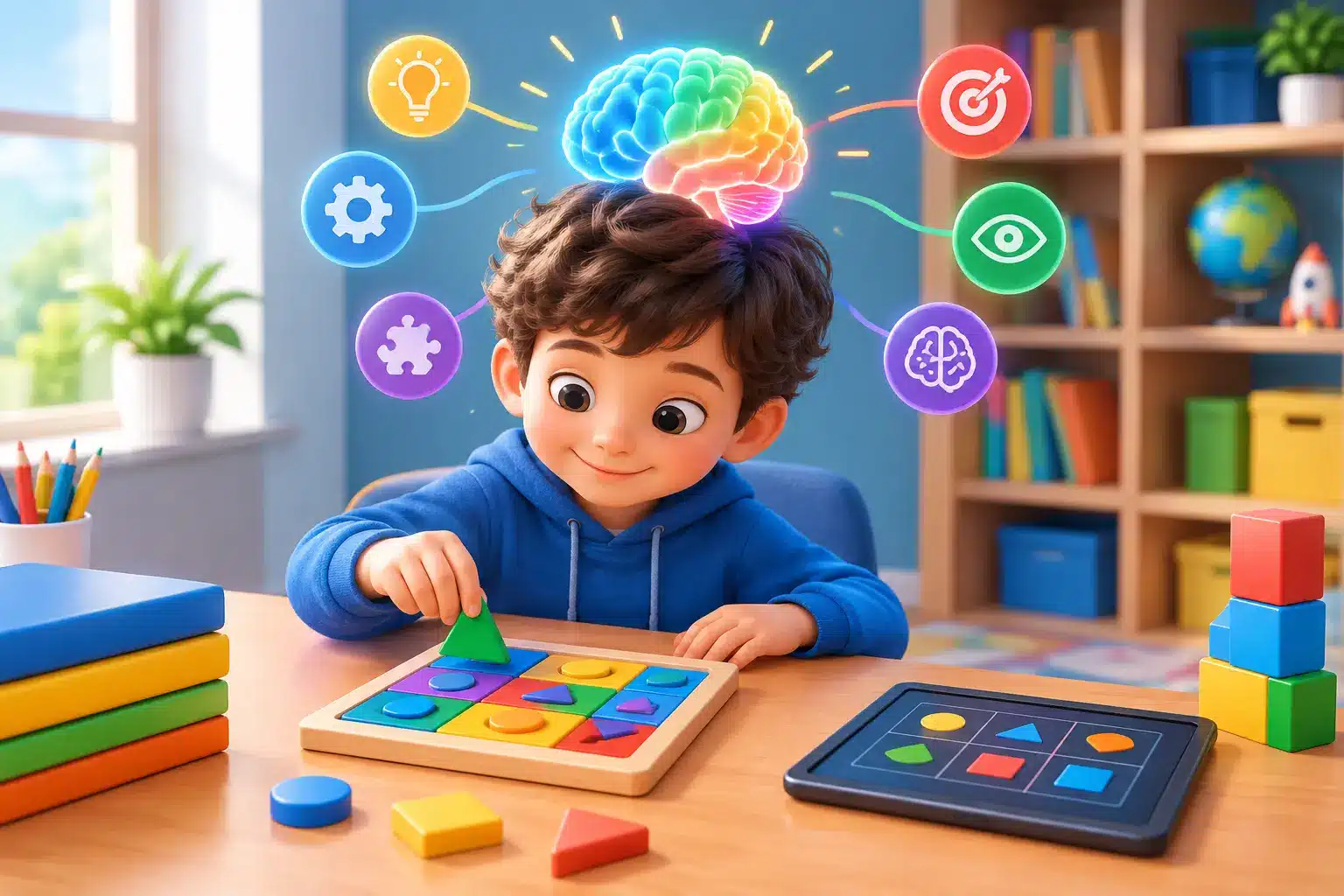
A child who loses their place while reading, forgets a two-step direction, or abandons homework after five minutes is not necessarily unmotivated. Often, the missing piece is a practice routine that makes attention, memory, and flexible thinking feel achievable. Beyin egzersizleri – brain exercises – can give families a practical way to build those skills through short, repeatable challenges rather than more pressure.
For parents of children with ADHD, dyslexia, learning differences, or uneven school performance, the goal is not to make a child sit still for longer just because adults ask them to. The goal is to help them notice how they focus, recover when distracted, and approach difficult tasks with more confidence. That distinction changes the entire routine.
What Brain Exercises Actually Practice
Brain exercises are structured activities that ask the brain to use a specific skill: holding information in mind, switching between rules, recognizing patterns, filtering distractions, or coordinating what the eyes see with what the hands do. A good activity has a clear challenge, immediate feedback, and a level of difficulty that can gradually change.
That matters because children do not build learning habits through effort alone. They need repeated opportunities to practice at a level that is demanding but not discouraging. If a game is far too easy, attention drifts. If it is consistently too hard, frustration takes over. The useful zone sits between those two extremes.
Neuroplasticity is the brain’s capacity to adapt through experience. It does not mean every game creates broad academic change, and it does not mean a single activity fits every child. It does mean that consistent, well-designed practice can support the skills children use while listening, reading, organizing, and completing tasks.
The skills parents often want to strengthen
Attention is usually the first concern, but it is rarely the only one. A child may also struggle with working memory, meaning they lose track of the instruction before they finish it. Another child may understand a lesson but have trouble with processing speed, visual tracking, or shifting from one task to the next.
This is why random worksheets are not always the best answer. A child who needs help noticing details may benefit from visual search activities. A child who rushes through directions may need simple listening-and-response games. The activity should match the skill you are trying to practice, not simply add more schoolwork to an already tiring afternoon.
Beyin Egzersizleri Work Best as a Routine
The most useful brain-training wellness practice is usually brief enough to repeat. For many children, 10 to 20 focused minutes several times per week is more realistic than one long session that ends in conflict. Consistency gives parents a chance to observe patterns and gives children enough repetition to become familiar with the challenge.
Start with a predictable time. Some families prefer a calm moment before homework, while others find that a short practice after a snack creates a cleaner transition from school to home. The best schedule depends on your child’s energy, sensory needs, and family rhythm. A child who is depleted at 6 p.m. may do much better with a short morning activity.
Keep the start simple. Explain what the activity is practicing in language your child can understand: “We are training our brain to spot the important detail,” or “Today we are practicing staying with one rule until the end.” This makes the task feel purposeful instead of punitive.
Then watch the quality of engagement, not only whether the child finishes. Did they return to the task after a distraction? Did they pause and correct an error? Did they use a calmer strategy when the challenge increased? These moments can be more meaningful than a high score on a single day.
Make progress visible without turning it into pressure
Children often hear plenty about what they missed, forgot, or did too slowly. A simple progress record can shift the conversation toward effort and awareness. After each session, ask one brief question: What felt easier today? What felt tricky? What strategy helped?
A parent can note session length, the type of challenge, and the child’s self-reported effort on a simple scale. Over a few weeks, this can reveal useful trends. Perhaps visual tasks are easier earlier in the day, or perhaps the child stays engaged longer when the task has a clear endpoint. These observations can help you adjust the routine instead of assuming the child is “not trying.”
Avoid using progress tracking as a scoreboard between siblings. Children develop at different rates and may need very different kinds of support. The point is to help each child recognize growth in their own skills.
Five Practical Activities to Try at Home
You do not need an elaborate setup to begin. Choose one or two activities, repeat them long enough to learn what they reveal, and rotate only when interest or challenge drops.
Pattern recall: Arrange three to five everyday objects in a sequence, let your child study them briefly, cover them, and ask them to rebuild the order. Increase difficulty slowly by adding an object or changing the rule from order to color or category. This can practice visual working memory.
Listening directions: Give a playful two-step instruction such as, “Touch something blue, then clap twice.” As it becomes easier, add a third step or ask the child to repeat the directions before doing them. Keep your tone light. The purpose is focused listening, not catching mistakes.
Visual scanning: On a page of letters, symbols, or household items, ask your child to find a target while ignoring similar-looking distractions. For a reader with dyslexia, use large, high-contrast print and short rounds. The challenge should feel manageable enough that the child can notice improvement.
Rule-switch games: Sort cards, buttons, or small objects by one rule, such as color. Then ask the child to switch and sort by shape. Switching rules can be difficult for children who get stuck on one approach, so praise the pause before the switch as much as the correct answer.
Rhythm and response: Clap a short pattern and invite your child to copy it. Later, make one agreed signal mean “freeze” or “reverse the pattern.” This combines attention, listening, timing, and flexible thinking in a way that often feels more like play than practice.
When Digital Feedback Adds Value
Paper-and-pencil activities are useful, but they cannot always show how a child’s attention changes moment to moment. Technology-supported brain-training practices can add immediate visual or sound-based feedback, which may help some children understand when they are engaged and when their focus has drifted.
EEG-based neurofeedback is one example of a brain-training wellness practice that uses brain-signal feedback during an activity. For families considering this option, the key questions are practical: Is the process age-appropriate? Is the child comfortable with the routine? How is progress observed over time? Can the practice fit alongside school, home routines, and the supports the child already uses?
Auto Train Brain is designed around this kind of measurable, family-centered practice. Still, no tool should become another source of pressure. If your child resists every session, the issue may be timing, task difficulty, sensory comfort, or the need for a different approach. Adjustment is part of thoughtful support.
What to Avoid When Building a Brain Exercise Routine
Do not frame practice as a consequence for poor grades or distracted behavior. A child who already feels behind may hear “brain exercise” as proof that something is wrong with them. Instead, present it as skill practice, much like learning a new move in a sport or a new chord on an instrument.
Also resist the temptation to change everything at once. A new homework system, earlier bedtime, extra tutoring, and daily exercises may be too much for a child who is already overwhelmed. Begin with one small routine, observe it for a few weeks, and make decisions based on what you actually see.
Finally, remember that attention is affected by sleep, hunger, emotional stress, sensory overload, and the demands of the school day. Brain exercises may support learning habits, but they are not a substitute for understanding the larger context of your child’s life. Guidance from your child’s physician or other qualified professional remains valuable when you have ongoing concerns. Individual results may vary.
The most encouraging change may not be a faster worksheet or a perfect homework night. It may be the moment your child says, “I lost focus, but I know how to start again.” That is a skill worth practicing.