


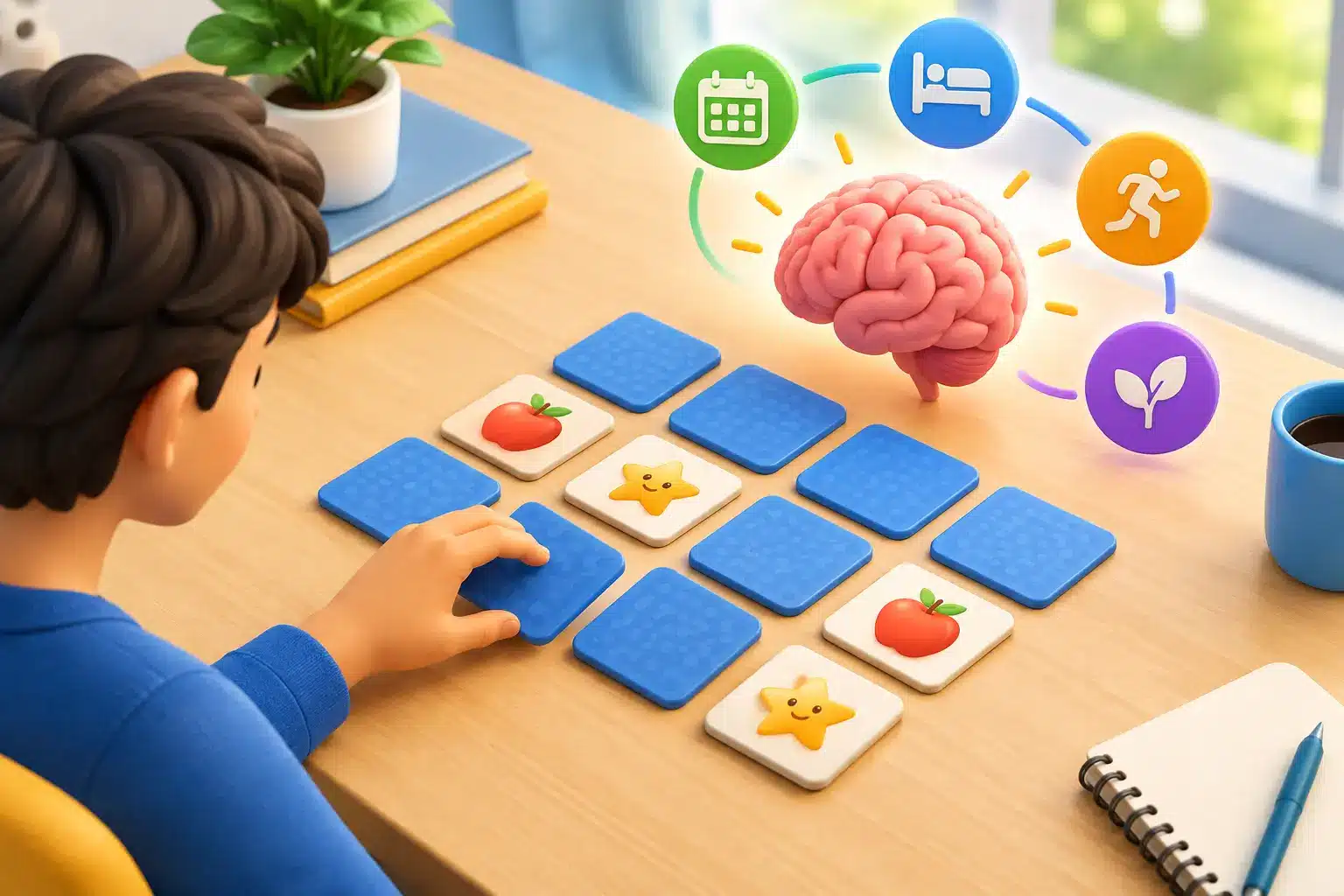
A child who forgets the second instruction before starting the first is not necessarily unmotivated or careless. Often, they are managing more information than their attention can hold at once. Hafıza oyunları, the Turkish phrase for memory games, can offer a low-pressure way to practice holding, sorting, and retrieving information through play.
For families supporting children with attention differences, reading challenges, learning differences, or autism-spectrum differences, the goal is not to turn every afternoon into another lesson. The better goal is to create short, repeatable moments where the child can notice progress without feeling judged. A well-chosen game can do that – especially when it is matched to the child’s age, energy, and interests.
Why memory games matter beyond remembering cards
Memory is not one single skill. A child may remember every dinosaur fact they hear yet struggle to retain a teacher’s multi-step direction. They may recall a song after one listen but lose their place while reading a paragraph. These patterns make sense when we look at the different mental tasks involved.
Working memory helps children briefly hold information while using it. Visual memory supports recognition of shapes, letters, faces, and patterns. Auditory memory supports following spoken directions and remembering sound sequences. Attention helps determine what gets registered in the first place.
That is why memory games are most useful when they are not treated as a test. They create repeated opportunities to focus, notice, wait, recall, and try a new strategy. Over time, this kind of practice may support the learning habits children use at school, during homework, and in everyday routines.
Neuroplasticity is part of the reason repetition matters. The brain changes through experience, particularly when an activity is engaging enough to repeat but not so difficult that the child wants to quit. One long, frustrating session rarely creates a helpful routine. Five focused minutes, practiced regularly, often has more value for building confidence and consistency.
Choosing hafıza oyunları for your child
The most impressive-looking game is not always the right one. A game should meet your child close to their current ability level, then offer a small stretch. If the challenge is too easy, attention drifts. If it is too hard, the game can become another experience of being “wrong.”
For preschoolers and early elementary students, start with fewer pairs, bold images, and familiar categories such as animals, foods, vehicles, or emotions. For older children, increase complexity through longer sequences, similar-looking images, timed rounds only if they enjoy them, or games that combine memory with planning.
A child who becomes overwhelmed by visual clutter may respond better to a simple grid with plenty of space between cards. A child who seeks movement may prefer a game in which picture cards are placed around the room and recalled after a short walk. A child who loves technology may stay engaged with a structured digital activity, while another may focus better with physical cards away from a screen.
The format matters less than the fit. Watch what happens after the first few rounds. Are they leaning in, laughing, and asking for another turn? Or are they avoiding eye contact, rushing randomly, or saying they are bad at it? Those reactions give you more useful information than a score alone.
Three memory skills worth practicing
Visual matching games ask children to remember where an image appeared. They can support careful scanning and pattern recognition. Keep the card set small at first, then add pairs gradually rather than changing everything at once.
Sequence games ask a child to repeat an order: colors, sounds, claps, movements, or numbers. These can be especially practical for children who need support remembering steps. Try clapping a two-part rhythm and inviting your child to copy it, then add one beat when the pattern feels comfortable.
Story recall games use meaning instead of isolated items. Read a short, interesting passage or describe a funny event, then ask what happened first, next, and last. This approach can feel more natural for children who dislike flashcard-style activities and can connect memory practice to reading comprehension.
Make the routine feel achievable
The best family routines are small enough to survive busy weeks. Rather than setting aside an hour, choose a predictable five- to ten-minute window: after a snack, before dinner, or while waiting for a sibling to finish an activity. Consistency gives the game a place in the day, so participation requires less negotiation.
Start with a clear finish line. You might say, “Let’s play three rounds,” instead of “Let’s practice memory.” The first version tells the child exactly what is expected. When the last round is complete, stop even if you think they could continue. Ending while the experience is still positive makes tomorrow’s session easier.
Your language matters, too. Praise strategies rather than labels. “You paused and looked carefully before choosing” is more helpful than “You’re so smart.” “You remembered the corner cards” helps a child notice what worked. This shifts attention from proving ability to experimenting with approaches.
If your child makes repeated mistakes, resist the urge to immediately correct every move. Ask a gentle question: “What could help you remember where that one was?” They may suggest grouping cards by color, checking the edges first, saying the item aloud, or making a small mental picture. Strategy talk is often where the learning becomes visible.
When competition helps – and when it does not
Some children light up when they are trying to beat a parent, a sibling, or their own previous score. Others lose interest the moment a winner is named. Neither response is a character flaw; it is a cue about how to shape the activity.
For a child who enjoys competition, keep it playful and specific. Compare today’s score with their own earlier score instead of constantly comparing siblings. For a child who is sensitive to losing, make the game cooperative: you both try to find all the pairs in a set number of turns, or you work together to remember a sequence.
Timed games are another trade-off. A timer can add excitement for a child who enjoys a challenge, but it can also crowd out thoughtful recall. If your child starts guessing faster and noticing less, remove the timer. The aim is engaged practice, not pressure.
How to notice meaningful progress
Progress does not always show up as a dramatic jump in the number of matches. It may appear in quieter changes: your child stays with the activity longer, uses a strategy without prompting, recovers more calmly after an incorrect answer, or asks to play again.
Keep a simple family record if your child enjoys seeing patterns. Once a week, note the game type, number of rounds, and one observation about effort or strategy. Avoid making every session a performance report. The record is there to help you notice growth that busy family life can otherwise hide.
It also helps to separate game performance from broader expectations. Doing well in a matching game does not automatically translate to remembering homework directions the next day. Skills transfer differently for every child and often need support in the setting where they are used. You can make that bridge more concrete by using similar language: “What memory strategy from our game might help with these two backpack steps?”
A balanced place for brain-training play
Memory games work best as one part of a fuller learning environment that includes sleep routines, movement, reading, conversation, school supports, and time to rest. They are not a shortcut around a child’s individual needs. But they can be a warm, practical way to practice attention and recall without adding another heavy demand to the day.
ATB Games-style brain-training activities can be especially useful when families want a more structured way to observe engagement over time. The key is still the same: choose an appropriate challenge, keep sessions brief, and let the child’s response guide the next step.
Tonight, try one small round with no pressure to improve. Put down six cards, turn them over, and let curiosity lead. The most valuable outcome may not be a perfect score. It may be the moment your child realizes, “I can try a different way.”