


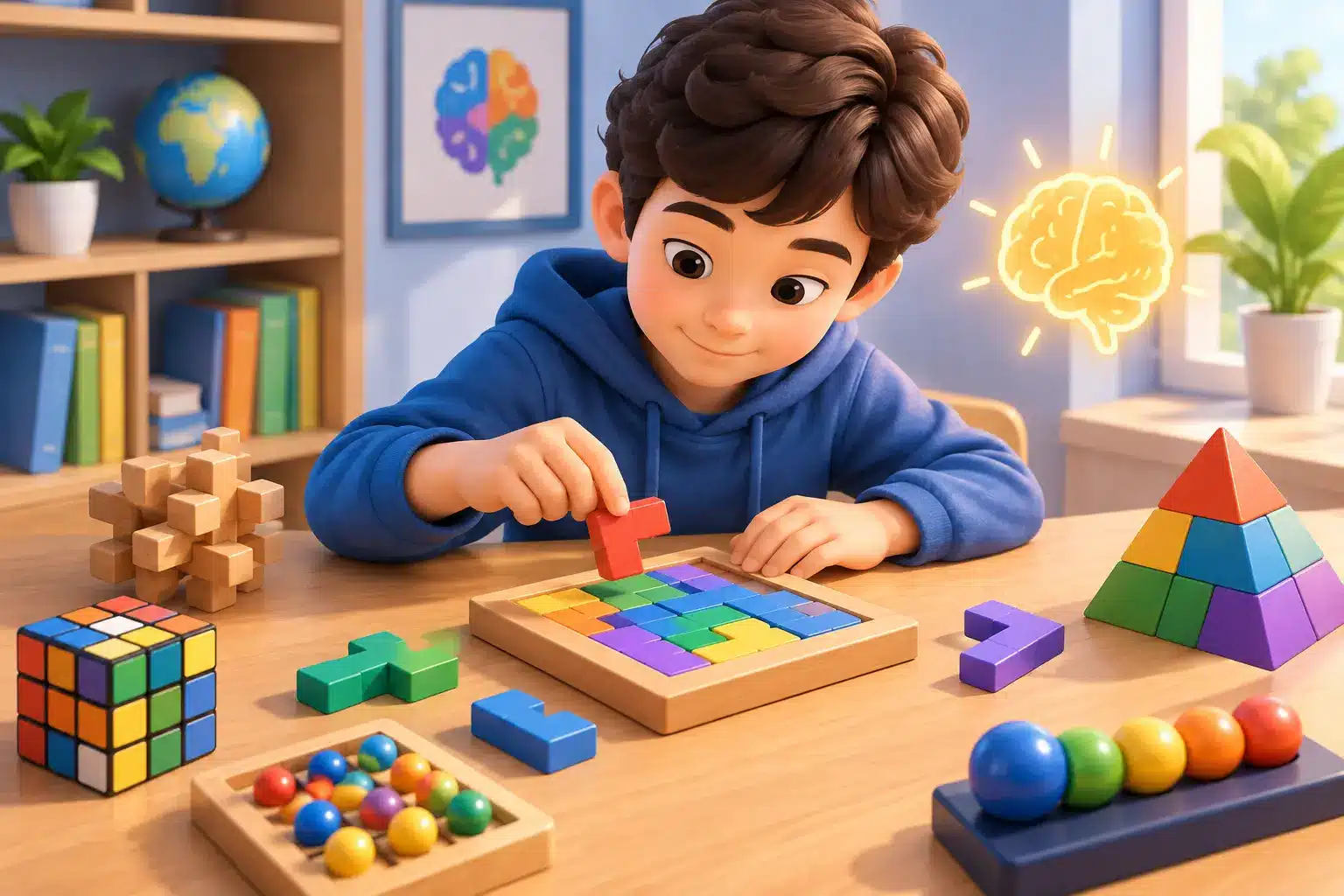
A child who abandons a puzzle after two minutes is not necessarily uninterested in learning. They may be meeting a task that is too difficult, too slow, or too disconnected from what motivates them. The right zeka oyunları can make that moment more productive by giving children a clear challenge, immediate feedback, and another chance to try a new strategy.
For families supporting children with attention differences, reading struggles, learning differences, or uneven academic confidence, games can be more than a way to fill waiting time. Used thoughtfully, they may support habits that matter at school and at home: staying with a task, noticing patterns, remembering rules, planning ahead, and recovering from mistakes without shutting down.
The key is not finding the hardest game or extending play for as long as possible. It is choosing a challenge your child can enter willingly, adjusting it when frustration rises, and noticing the skills behind the score.
What Zeka Oyunları Can Practice
Zeka oyunları is a broad term. It can include logic puzzles, visual matching activities, strategy board games, spatial challenges, memory games, wordplay, and digital problem-solving activities. These games do not all build the same abilities, so choosing by age label alone often leads to disappointment.
A visual pattern game may invite a child to compare details and hold information in mind. A strategy game can ask them to wait, predict consequences, and revise a plan. A word game may encourage flexible retrieval of language, while a puzzle with physical pieces can strengthen spatial reasoning and persistence. The game itself matters less than the mental process it repeatedly invites.
For a child who struggles to begin homework, a short game with a clear first move may be more useful than an open-ended challenge. For a child who rushes through work, turn-based games can create natural practice in pausing and checking. For a child who becomes discouraged quickly, cooperative puzzles can offer challenge without making a sibling or parent feel like an opponent.
This is why one family’s favorite game can be another child’s frustration trigger. The best choice depends on the child’s current skills, interests, energy level, and relationship with competition.
Start With the Skill, Not the App
Before downloading another game or buying another box, name one skill your family wants to practice this week. Keep it concrete. Instead of aiming for better focus, you might choose finishing a short task, remembering two-step directions, waiting for a turn, or trying a second approach after an error.
That small shift changes how you evaluate play. A child who does not win may still have had a meaningful session if they stayed engaged for five minutes longer than usual or explained why they changed their move. Those observations are often more useful than a leaderboard.
For attention and task persistence
Choose games with short rounds, visible goals, and limited rules. A child who is easily pulled away may do better with a three-minute visual search activity than a 45-minute strategy game. As their tolerance grows, you can add one more round or introduce a slightly more complex rule.
Avoid using the game as a test of whether your child can pay attention. Pressure can turn a playful exercise into another situation where they feel watched. Instead, sit nearby, notice effort, and use simple language such as, “You came back to the puzzle after that tricky part.”
For planning and flexible thinking
Strategy games, maze puzzles, construction challenges, and logic tasks can be helpful when they require children to consider more than one option. Ask questions that keep ownership with the child: “What do you think will happen if you try that?” or “Is there another route?”
Try not to supply the answer too quickly. A pause can feel uncomfortable for adults, especially when a child is stuck. Yet that pause is often where planning begins. Offer a small hint only after your child has had room to look, guess, and reconsider.
For working memory and pattern recognition
Matching games, sequence games, card games, and pattern-building activities can provide repeat practice without looking like a worksheet. Start with fewer pieces or shorter sequences than you think your child needs. Early success creates willingness to continue, while repeated failure teaches a child to avoid the activity.
If a digital game changes difficulty automatically, watch whether the increase is motivating or overwhelming. Adaptive challenge can be useful, but only when your child still experiences enough successful moments to stay curious.
The Right Difficulty Has a Sweet Spot
A useful zeka oyunları session should ask for effort without producing constant defeat. If your child solves every round instantly, the game may be entertaining but offers little room for new strategy. If they become upset before they understand the goal, it is probably too difficult for that moment.
Look for what educators often call productive struggle. Your child may sigh, pause, or ask for a clue, then continue. They are challenged, but not flooded. That balance is especially valuable for children whose confidence has been shaped by frequent correction in school settings.
You can adjust difficulty without replacing the game. Reduce the number of cards. Cover part of a busy board. Let your child see the pattern for a few extra seconds. Play cooperatively before introducing competition. These changes are not shortcuts. They create an entry point from which more independence can grow.
Build a Routine That Does Not Feel Like Another Assignment
Consistency matters more than marathon sessions. Ten to fifteen focused minutes, two or three times each week, is often easier for families to sustain than a strict daily schedule. Attach game time to a routine that already exists, such as after an afternoon snack, before dinner, or during a weekend morning.
Let your child have some say in the choice. Offering two options protects structure while giving them agency: “Would you rather do the pattern challenge or the logic cards?” When children feel they have a voice, they are more likely to return to the activity.
It also helps to end while the experience is still positive. Waiting until your child is exhausted or upset can make the next session harder to begin. A simple closing ritual, such as putting away pieces together and naming one strategy that worked, helps the game feel complete.
Screens deserve a balanced approach here. Digital games can provide responsive feedback and engaging visual formats, particularly for children who resist paper-based activities. At the same time, not every colorful, fast-moving app asks for meaningful thinking. Choose games with a clear objective, manageable sensory load, and room for reflection. Mix screen-based play with physical puzzles, cards, movement, and conversation.
Make Progress Visible Without Turning It Into Pressure
Families often ask how to know whether a game is helping. Scores can be one clue, but they should not be the whole story. Notice behavior over several weeks. Is your child starting more independently? Do they tolerate a mistake with less frustration? Can they explain a strategy they used? Are they more willing to return to a challenge?
A simple family note can make these changes easier to see. Record the game, the length of play, the level of support needed, and one observation. Keep it neutral. “Needed two reminders to return to the game” is more useful than “was distracted.” “Tried a new route after the first one failed” captures growth that a score might miss.
At ATB, we encourage families to view brain-training activities as a wellness and educational practice, not as a race for instant results. A game becomes more valuable when adults use what they observe to choose the next right challenge.
When Games Are Not Working
If game time regularly ends in conflict, do not assume your child is being difficult or that they lack motivation. The format may not fit. Competition may be too intense, instructions may be too dense, or the activity may arrive at the end of an already demanding day.
Change one variable at a time. Try a cooperative version, shorten the round, reduce background noise, or let your child teach you how they want to play. If frustration remains high, take a break and return later with a different type of challenge. A child does not need to enjoy every zeka oyunları activity to benefit from playful problem-solving.
This content is educational wellness information and does not replace physician advice. Individual results may vary.
The most meaningful game may be the one that gives your child a new experience of challenge: not something to escape, but something they can approach, think through, and try again tomorrow.