


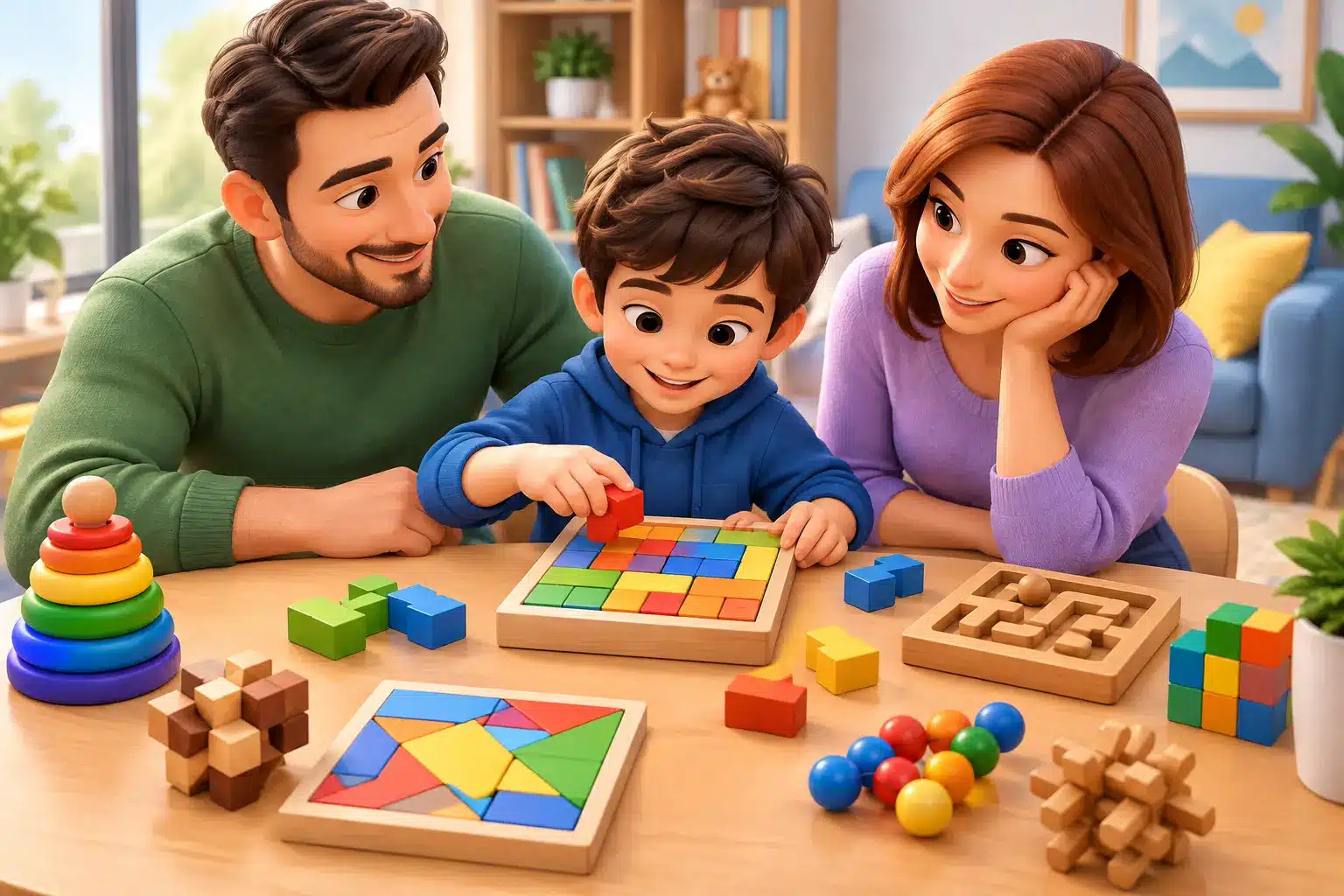
A child who leaves a puzzle halfway through is not necessarily “bad at focus.” They may be tired, overwhelmed by too many pieces, unsure where to begin, or simply uninterested in that type of challenge. That is why çocuklar için zeka oyunları work best when they are chosen as an invitation to think and explore, not as another performance test.
For families supporting children with attention differences, dyslexia, learning challenges, or autism spectrum differences, play can offer a lower-pressure space to practice key skills. The goal is not to make every game educational. It is to create short, repeatable moments in which your child can notice patterns, make choices, recover from mistakes, and experience progress.
Why brain games can matter beyond “being smart”
A good thinking game asks for more than a right answer. It may invite a child to hold instructions in mind, scan for visual details, wait for a turn, try a different strategy, or explain a choice. These are everyday learning behaviors, and they influence how children approach homework, reading, routines, and social play.
The most useful games do not need to be complicated. In fact, a game that is too difficult can quickly become frustrating, especially for a child who already spends much of the school day working hard to keep up. A game that is too easy, on the other hand, may feel boring. The productive middle is a challenge your child can enter independently, with just enough support to keep moving.
This is where neuroplasticity is a helpful idea for parents. The brain adapts through repeated experience. When a child practices noticing, remembering, planning, and trying again in a positive setting, those experiences may support the development of learning habits over time. Progress rarely looks dramatic from one game session to the next. It is more often visible in small changes: a longer attempt, fewer reminders, a calmer response to an error, or more willingness to begin.
How to choose çocuklar için zeka oyunları
Start with the skill your child is ready to practice, but do not reduce them to a label. Two children with similar school concerns may enjoy entirely different activities. One may love visual puzzles and dislike word games; another may thrive with a fast verbal challenge but lose interest in building tasks.
Match the game to the child’s current energy
A strategic board game after a demanding school day may be too much. At that moment, a simple matching activity, a short observation game, or a cooperative challenge may be a better fit. Save higher-effort games for a time when your child is rested and receptive.
A useful rule is to stop while the experience still feels positive. Ten engaged minutes can be more valuable than forty minutes of pushing through frustration. If your child asks to return to the activity tomorrow, you have found something worth repeating.
Look for one clear challenge at a time
Some games require memory, speed, reading, turn-taking, and visual scanning all at once. They can be fun, but they may also hide the reason a child is struggling. Early on, choose games with a clearer focus.
For example, a sequence-copying activity emphasizes working memory. A “find the difference” challenge emphasizes visual attention. Sorting objects by changing rules supports flexible thinking. Once your child feels comfortable, you can gradually introduce games that combine skills.
Keep reading demands separate when needed
Children with dyslexia or reading fatigue may have strong reasoning skills that are obscured by text-heavy instructions. Choose visual, tactile, or verbal games when you want to see how they solve problems without the added load of decoding words.
This does not mean avoiding word play altogether. Short riddles, sound games, and storytelling prompts can be enjoyable when they are adapted to the child’s level. The key is to make the thinking task visible rather than turning every round into a reading test.
Game types that support different ways of thinking
You do not need a shelf full of specialized products. Everyday materials and familiar games can create meaningful practice when used with intention.
Visual-spatial challenges
Tangrams, block patterns, mazes, hidden-object pictures, and simple construction challenges invite children to notice shape, position, and sequence. These activities can work well for children who think visually and enjoy using their hands.
Try giving a child a model to copy, then ask what they noticed first. Did they begin with the corners? Did they group matching colors? Their answer matters more than whether they finish quickly because it reveals the strategy they are building.
Memory and attention games
Card matching, “what changed?” games, and rhythm-copying activities can support sustained attention and working memory. Begin with a small number of items. Increasing difficulty too quickly can turn a playful task into a discouraging one.
If your child has attention differences, add movement rather than demanding stillness. Place matching cards across the room, clap a pattern before repeating it, or let them point and explain instead of waiting silently. Attention often improves when the format respects a child’s need to move.
Logic and flexible-thinking games
Riddles, sorting challenges, pattern completion, and rule-switching games help children consider more than one possibility. A simple example is sorting buttons first by color, then by size, then by number of holes. The shift in rule is the challenge.
When a child gets stuck, avoid stepping in with the answer immediately. Offer a prompt such as, “What have you already tried?” or “Which piece gives you the most information?” This protects their sense of ownership while giving them a path forward.
Cooperative games
Competitive games are not wrong, but they are not always the best starting point. For children who become upset when losing, cooperative play can build planning, communication, and persistence without placing one person in the role of winner and another in the role of failure.
Set a shared challenge: build the tallest structure with limited materials, solve a puzzle before a timer ends, or create a story using three unexpected objects. Adults should participate as teammates, not directors. Let your child see you revise a plan and laugh at your own mistakes.
The parent’s role: guide, not scorekeeper
The language you use during play shapes the experience. Praise that focuses only on being “smart” can make children afraid to fail. Instead, name the action you observed: “You looked carefully before choosing,” “You changed your plan,” or “You stayed with that even when it got tricky.”
This approach is especially valuable for children whose confidence has taken a hit from difficult school experiences. A game can become a small place where they are known for curiosity and persistence, not just for what they find hard.
It also helps to separate play from constant measurement. You can notice patterns without turning every session into data collection. Keep a simple mental record of what helps: shorter rounds, visual instructions, movement breaks, a quieter room, or playing alongside a sibling. These observations can make your family’s routines more responsive.
When screens are part of the plan
Digital brain games can be engaging, particularly when they offer brief activities, clear feedback, and adjustable difficulty. But a colorful screen alone does not make an activity meaningful. Consider whether your child is making choices, practicing a specific skill, and remaining emotionally regulated during play.
Balance screen-based games with hands-on and social options. Physical materials can reduce distractions and make it easier for a child to show how they think. Shared games also offer something many apps cannot fully replicate: conversation, turn-taking, and the reassuring presence of a supportive adult.
For families looking for a more structured brain-training wellness practice, tools that use neurofeedback may complement educational routines by helping make engagement more observable. Auto Train Brain is designed around this kind of science-backed, parent-guided practice. It should be approached as one part of a wider learning and wellness routine, shaped around your child’s individual needs.
A simple weekly rhythm that is easier to maintain
Consistency matters more than intensity. Choose two or three short play windows each week and rotate activity types. One day might feature a visual puzzle, another a movement-based memory game, and another a cooperative family challenge. Variety helps you see what genuinely draws your child in.
If an activity repeatedly ends in tears, refusal, or shutdown, it is useful information, not a reason to push harder. Simplify the game, shorten the round, play together, or choose a different skill for now. The right challenge can change as a child grows, sleeps better, enters a new school routine, or gains confidence.
Not a medical device – does not replace physician advice. Individual results may vary.
The best game is often the one your child asks to play again, because repeated, willing practice creates room for the small wins that gradually change how a child sees their own ability to learn.