


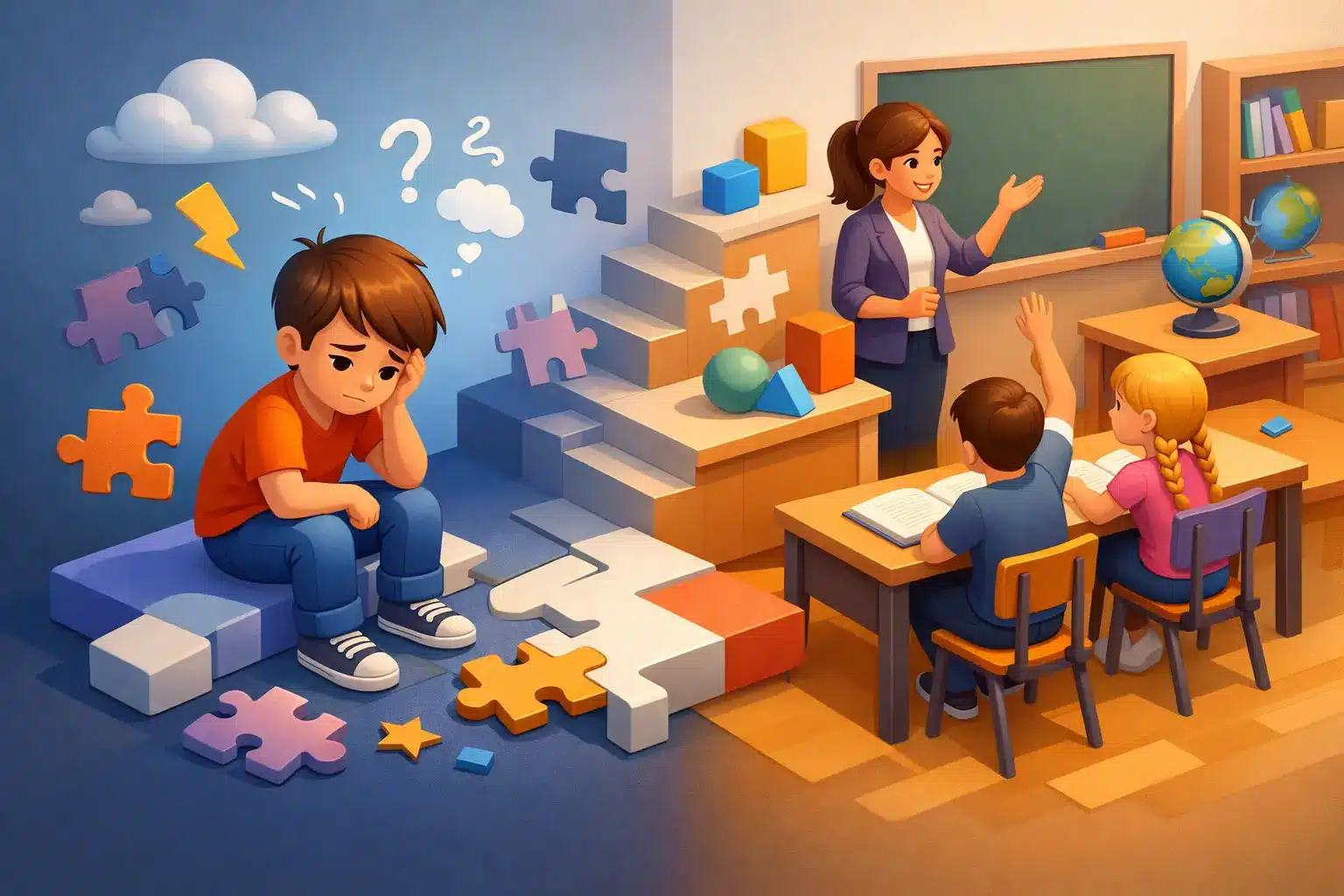
A child who can explain a science experiment beautifully may still freeze when asked to read a short paragraph aloud. Another may understand a story when listening, yet struggle to put the same ideas on paper. A learning disability in children can look like inconsistency from the outside, but it is not a sign of low intelligence, laziness, or a lack of effort.
For many parents, the hardest part is watching a capable child begin to say, “I’m stupid,” “I hate school,” or “I can’t do this.” The most useful next step is not to push harder. It is to understand the pattern, protect confidence, and build the right kind of support around how your child learns.
What a Learning Disability Can Look Like at Different Ages
Learning differences do not show up in exactly the same way for every child. They can affect reading, writing, spelling, math, organization, attention during schoolwork, or the ability to process instructions efficiently. A child may have one area of difficulty or several that overlap.
In early elementary years, families may notice that learning letter sounds takes longer than expected, rhyming is difficult, or a child avoids books despite enjoying being read to. They may reverse letters beyond the early learning stage, lose their place while reading, or need far more repetition than peers to remember spelling patterns.
By later elementary and middle school, the signs may become less obvious but more emotionally costly. A child may read slowly, skip small words, struggle to turn thoughts into written assignments, or take an unusually long time to finish homework. Math facts may not stick, multi-step problems may feel overwhelming, and organization can become a daily source of conflict.
Teenagers sometimes compensate so well that adults miss the effort involved. They may rely on memorization, avoid classes that require extensive reading, procrastinate because assignments feel unmanageable, or become exhausted after a school day. Strong verbal skills can also mask difficulty with written work.
A single behavior does not tell the full story. Children can struggle temporarily because of a new school, disrupted sleep, anxiety, language differences, vision concerns, or gaps in instruction. What matters is a persistent pattern that affects learning, participation, and self-belief.
Why “Try Harder” Usually Makes Things Worse
When a child needs three times as long to decode a page or organize a paragraph, effort is often already present. Adding more pressure can turn learning into a threat response. The child may resist homework, shut down, argue, or appear distracted because the task feels like another chance to fail.
This is where a parent’s language matters. Instead of, “You know this, just focus,” try, “This looks like it is taking a lot of energy. Let’s find the part that is getting stuck.” The first statement can sound like blame. The second creates room for observation and problem-solving.
Children also benefit from hearing that brains learn in different ways. Neuroplasticity, the brain’s ability to adapt through practice and experience, does not mean every challenge disappears with enough repetition. It means skills can be supported through targeted practice, useful strategies, consistency, and an environment that does not shame mistakes.
Start With Clear Information, Not Guesswork
If schoolwork has become a repeated struggle, begin by collecting specific examples. Keep a brief record of what takes extra time, what triggers frustration, and what helps your child re-engage. A vague concern such as “reading is hard” becomes much more actionable when you can describe the pattern: “He understands audiobooks but loses meaning when reading independently,” or “She can solve math problems verbally but becomes stuck when copying them onto the page.”
Talk with your child’s teacher about classroom observations, work samples, and whether the difficulty appears across subjects. Ask what interventions or learning supports have already been tried and how progress is being tracked. In U.S. public schools, families can also ask about the school’s process for determining eligibility for educational support under IDEA, the Individuals with Disabilities Education Act.
The goal is not to label a child too quickly. It is to understand the learning profile well enough to make better decisions. Some children need explicit reading instruction. Some benefit from assistive tools such as text-to-speech or speech-to-text. Others need assignments broken into smaller sections, extra time, visual schedules, or a quieter setting for complex work.
Questions That Lead to Better School Conversations
Ask what your child can do independently, what requires adult prompting, and where errors tend to happen. It can also help to ask whether the challenge is with understanding information, remembering it, beginning a task, organizing it, or showing knowledge in writing.
These questions shift the conversation away from whether a child is “behind” and toward what conditions help them participate and demonstrate what they know. That distinction can change the entire tone of a school meeting.
Build a Home Routine That Protects Confidence
Home should not feel like a second full school day. A predictable routine can reduce friction, but the routine needs to match your child’s capacity. Some children do best with a movement break before homework. Others need a snack, a quiet transition, and a clearly defined start time.
Break larger assignments into visible steps. Rather than saying, “Finish your homework,” try, “Read the first section, answer two questions, then take a five-minute break.” A timer can help, but only if it feels like a boundary that protects effort rather than a countdown to failure.
When reading is difficult, preserve access to ideas. Read aloud together, use audiobooks when appropriate, and let your child discuss what they understood. When writing is difficult, allow them to say their ideas first, create a simple verbal outline, or use speech-to-text when it fits the assignment. These supports do not lower expectations. They can reduce unnecessary barriers while a child builds skills.
Praise strategy and persistence with precision. “You noticed that long word and broke it into parts” is more useful than “Good job.” Specific feedback helps children see that learning is a process they can influence.
Support Attention Without Making Every Moment a Battle
A learning difference and attention challenges can overlap, but they are not interchangeable. A child who looks away during reading may be avoiding a task that feels too difficult. A child who forgets instructions may need them presented one step at a time, in writing, rather than repeated more loudly.
Consider the learning environment before assuming motivation is the issue. Is the desk crowded? Is the task too long? Does your child know what “finished” looks like? Is there a choice between starting with reading or math? Small adjustments can reduce the number of decisions a child has to make before they can begin.
Sleep, meals, movement, and screen routines also affect readiness to learn. There is no universal schedule that works for every family, but consistency gives children fewer moving targets. The right plan is the one your family can maintain without turning evenings into a power struggle.
Where Brain-Training Wellness Practices May Fit
Educational supports, family routines, and school collaboration remain central. Some families also explore structured neurofeedback or brain-training wellness practices as part of a broader approach to attention, self-regulation, and learning readiness.
At Auto Train Brain, EEG-based neurofeedback is presented as an educational and wellness practice designed around real-time feedback and measurable engagement. It may support families who want to understand patterns and build a consistent practice alongside school-based learning supports. It is not a substitute for individualized guidance from qualified education or health professionals, and individual results may vary.
Before choosing any added program, ask practical questions: How often will it be used? What will progress tracking look like? Is the routine realistic for your child? Does it respect your child’s energy, interests, and existing commitments? A promising tool that creates more stress than structure may not be the right fit right now.
Help Your Child Keep Their Identity Bigger Than Schoolwork
Children need experiences where they feel capable that have nothing to do with a worksheet. Art, building, music, sports, cooking, coding, animals, games, and hands-on projects can offer meaningful proof that ability has many forms.
Avoid discussing a child’s struggles in front of them as if they are not in the room. Invite their perspective instead. Ask which parts of school feel hardest, which adults make learning easier, and what they wish others understood. Even young children often have remarkably clear insight when they feel heard.
Your child does not need to earn respect by performing like everyone else. With clearer information, appropriate support, and steady encouragement, they can learn to recognize their strengths while building the skills that make school and daily life feel more manageable.
Auto Train Brain is not a medical device. It does not diagnose, treat, cure or prevent any disease or condition, and it is not a substitute for assessment, diagnosis or care from a qualified professional. Results vary from person to person and are not guaranteed.