


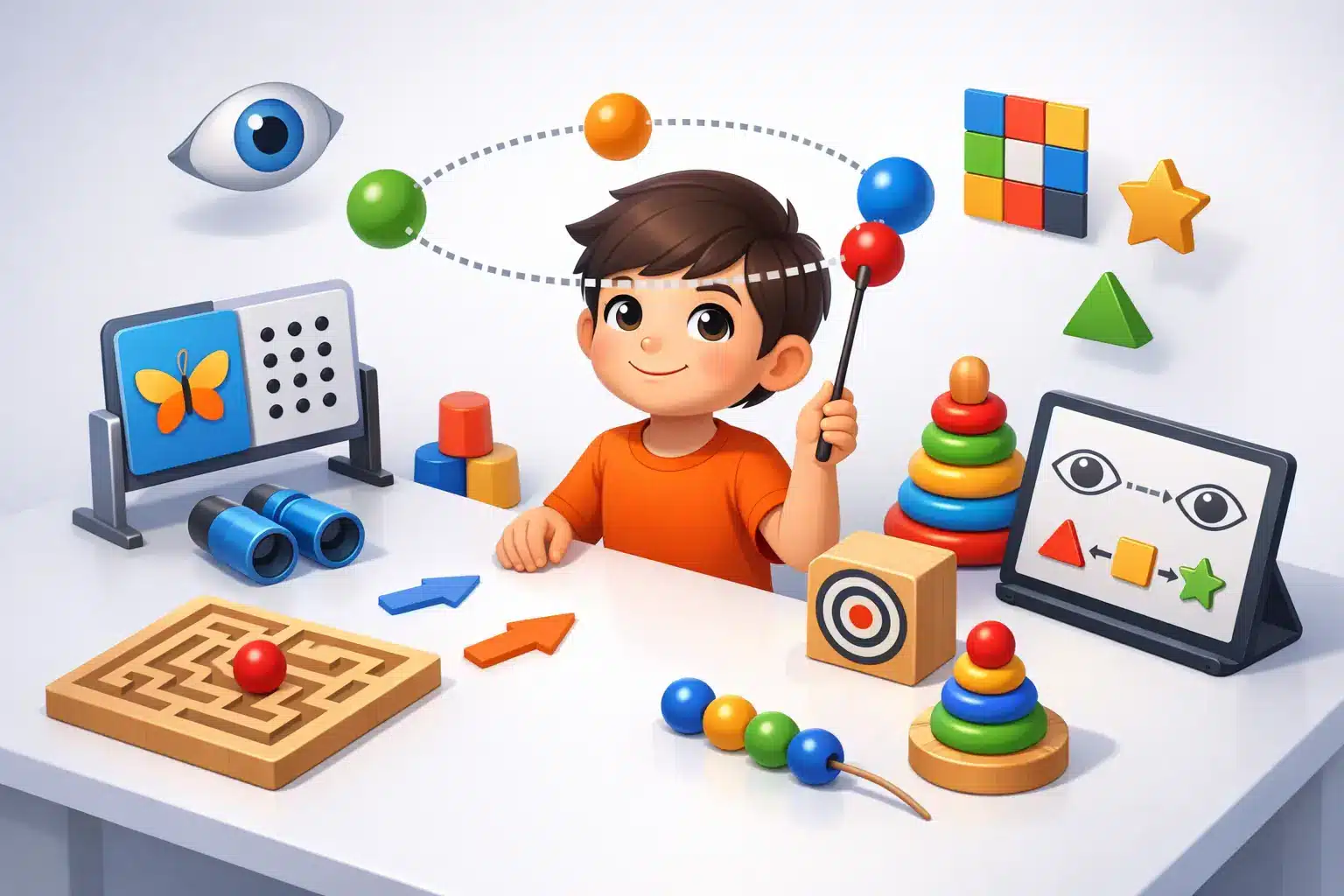
A child who loses their place every other line, rubs their eyes after homework, or avoids ball games is not necessarily being careless. Reading, copying from the board, tracking a moving target, and shifting focus from near to far all ask the visual system to work in coordinated ways. That is why many parents explore eye exercises for kids. The useful question is not whether a game can magically fix every concern. It is whether a short, enjoyable activity can help a child practice specific visual skills without turning another part of the day into a struggle.
For children with attention differences, dyslexia, learning challenges, or sensory sensitivities, the best activities tend to feel like play. They are brief, predictable, and matched to what the child can comfortably do. A five-minute routine completed willingly is often more valuable than a long routine that creates frustration.
What eye exercises for kids can support
Eye exercises are structured activities that invite children to use skills such as visual tracking, focus shifting, eye teaming, and visual attention. Those skills matter during everyday tasks. A child may use tracking to follow a sentence across a page, focus shifting to look from a worksheet to a teacher, and eye-hand coordination to catch a beanbag.
These activities may support practice and awareness, especially when a child has trouble sustaining visual attention during close-up work. They can also offer a welcome movement break between reading, writing, and screen time. For some children, slowing down and practicing one skill at a time can make demanding tasks feel more manageable.
There are limits worth stating clearly. Eye games do not replace glasses, contact lenses, or a personalized plan from an eye-care professional. They are not a shortcut for reading differences, attention differences, or developmental needs. A child’s reading experience involves language, sound processing, attention, instruction, confidence, and visual skills working together. When parents hold that bigger picture, eye exercises can become one small, practical support rather than a source of unrealistic pressure.
Start with the skill, not the trend
Online videos often promise a single exercise for every child. In real family life, it depends on what you are seeing. A child who skips words while reading may benefit from gentle tracking games. A child who becomes restless after close-up work may respond better to a near-to-far focus break. A child who dislikes worksheets may engage more readily with a balloon, flashlight target, or scavenger hunt.
Before choosing an activity, notice patterns for a week. Does the challenge show up mainly during reading? Is it worse late in the day? Does it happen with screens, handwriting, sports, or all of the above? These observations give you a more useful starting point than trying ten exercises at once.
Tracking games for following movement
Tracking means following something smoothly with the eyes. It is used when reading from left to right, watching a ball, or locating information on a busy page.
Try a slow finger trail. Hold one finger about an arm’s length from your child and move it slowly in a horizontal line, then a vertical line, then a gentle circle. Ask them to follow with their eyes while keeping their head as still as is comfortable. Keep the motion unhurried. Fast movements can turn the activity into guessing rather than practice.
A balloon rally offers a more playful version. Tap a balloon gently back and forth and invite your child to watch it from the moment it leaves a hand until it lands. If coordination is challenging, begin by letting the balloon fall onto a couch cushion or a laundry basket. The goal is attentive watching, not athletic performance.
For early readers, place a small card under each line of a favorite book and slide it downward as your child reads. This is not an exercise in forcing speed. It simply reduces visual clutter and gives the eyes a clear place to return to.
Focus-shifting breaks for close-up work
Schoolwork often keeps children looking at one distance for long stretches. Focus-shifting games create a simple change of visual demand.
Choose an object near the child, such as a sticker on a pencil, and another object farther away, such as a picture across the room. Invite them to look at the near object for a few calm seconds, then the far object, then back again. Use playful language: find the tiny target, then find the far-away target. Five to ten relaxed switches are plenty for a first try.
This can fit naturally into homework. After one short section of reading or writing, stand up, look across the room, stretch, take a sip of water, and return. The movement matters too. Children who find sitting difficult often benefit more from a whole-body reset than from being asked to stay still and concentrate harder.
Eye-hand coordination through play
Visual coordination grows through ordinary play. Tossing soft objects into a basket, rolling a ball along a taped line, building with blocks, tracing simple paths, and copying a pattern with colored tiles all invite the eyes and hands to work together.
Keep the challenge just above your child’s current comfort level. If catching is frustrating, roll the ball first. If a maze feels overwhelming, use a wider path or let the child trace it with a finger before using a pencil. Small adjustments protect confidence, which is especially meaningful for children who already associate school tasks with correction.
A five-minute routine children may actually accept
Consistency matters more than complexity. Pick one calm time of day, such as before homework, after school, or before a favorite game. A simple routine can include four short parts:
- Follow a finger or small target slowly for one minute.
- Shift focus between a near and far object for one minute.
- Roll, toss, or track a balloon for two minutes.
- Finish with one minute of looking across the room, stretching, or quiet breathing.
Invite your child to help choose the target, ball, or storybook. Choice turns the activity from something done to them into something they can own. If they are tired, irritated, or overwhelmed, pause. Progress is not measured by pushing through discomfort.
Common mistakes that make practice less useful
The biggest mistake is doing too much too soon. Parents understandably want a clear plan, particularly when homework has become a daily battle. But long drills can make children associate visual practice with another demand they cannot meet. Start small and observe what helps.
Another mistake is making eye exercises a test. Avoid comments such as, You missed it again, or, Try harder to focus. Instead, describe what you notice: You stayed with the balloon longer today, or, That line tracker helped you find your place. Specific encouragement teaches children that skills can be practiced without suggesting that they are failing.
It also helps not to stack every support into one session. If a child is using a reading guide, a timer, movement breaks, and a new visual game, introduce them gradually. Otherwise, it becomes difficult to tell what is helping and what is simply adding noise.
When a child needs more than an at-home game
Reach out to an eye-care professional when concerns are frequent, increasing, or interfering with school, play, or daily comfort. Examples include regularly holding books very close, covering one eye, frequent squinting, persistent headaches during visual tasks, seeing double, losing their place despite support, or avoiding activities they previously enjoyed.
A school vision screening can be useful, but it does not answer every question about how a child uses visual skills throughout the day. Bring concrete observations with you: what happens, when it happens, and what seems to ease it. That information helps families make thoughtful next-step decisions.
For children with neurodevelopmental differences, collaboration is especially valuable. Their learning needs are rarely explained by one factor alone. A supportive routine at home, responsive school strategies, and guidance from qualified professionals can work alongside one another while keeping the child’s energy and self-esteem in view.
The most encouraging eye exercises for kids are often the least dramatic: a balloon floating across the room, a finger tracing a slow path, a pause to look out the window before returning to a page. When practice feels calm, brief, and achievable, it can give your child one more way to approach demanding visual tasks with curiosity instead of dread.