


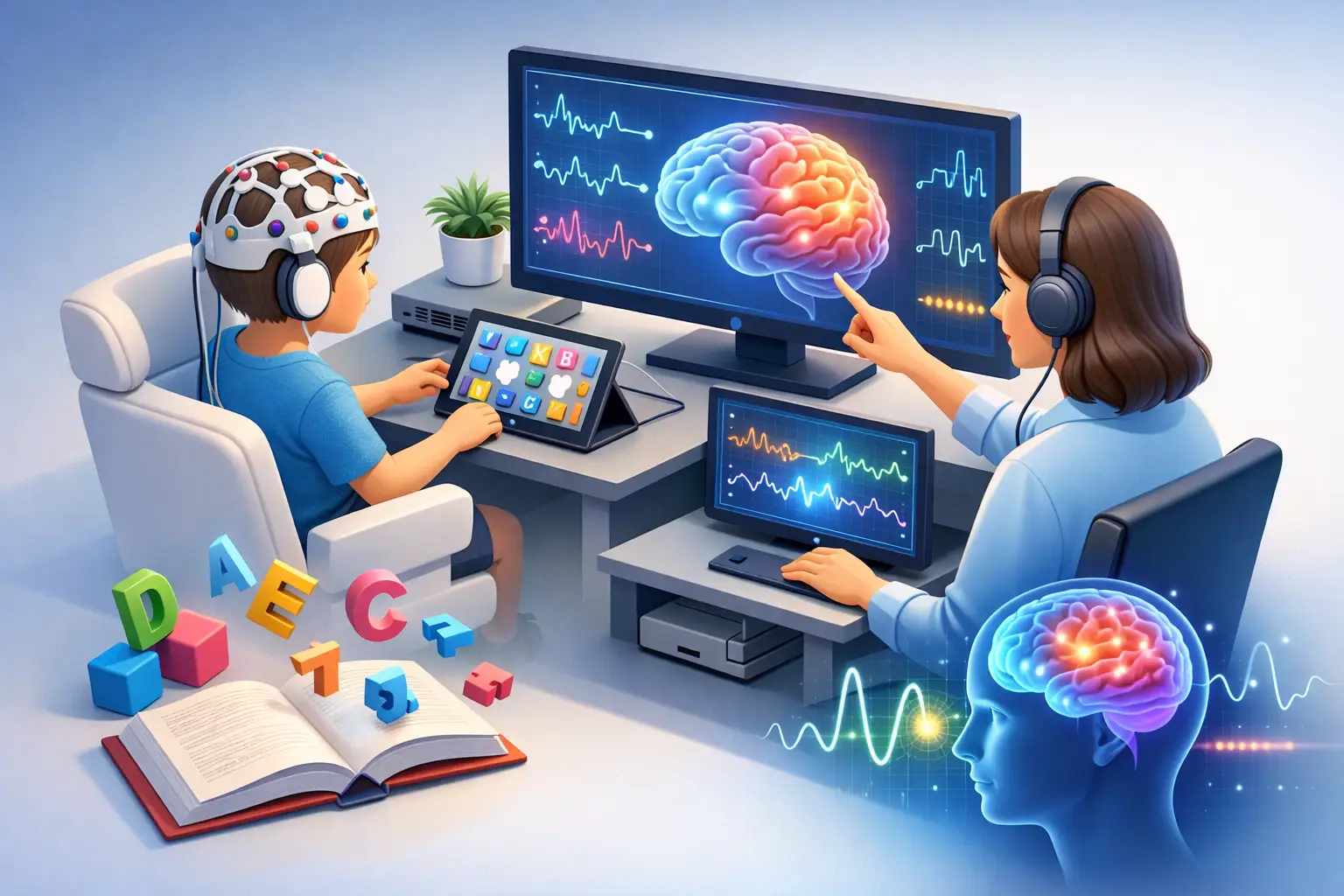
Reading can look like a simple school skill from the outside. For a child with dyslexia, it often feels very different – slow decoding, skipped lines, mental fatigue, and growing frustration even when effort is high. That is why many parents start asking how eeg neurofeedback helps dyslexia, especially when tutoring alone does not seem to address attention, processing, and reading stamina together.
How EEG neurofeedback helps dyslexia in real life
The short answer is that EEG neurofeedback can help some children with dyslexia by training the brain toward more efficient patterns linked to attention, self-regulation, timing, and cognitive endurance. Dyslexia is not caused by low motivation or poor parenting. It is a brain-based learning difference that often affects phonological processing, reading fluency, working memory, and speed of retrieval.
When a child is trying hard but still struggles to connect sounds to letters, keep focus on a line of text, or read without exhausting effort, the issue is rarely just practice. The brain may be working inefficiently during reading tasks. EEG-based training aims to measure those patterns and provide real-time feedback so the child can gradually strengthen more useful brain states through neuroplasticity.
For parents, this matters because reading success is not only about decoding instruction. A child also needs sustained attention, emotional regulation, and enough mental energy to stay with the task. If those systems are under strain, reading practice becomes harder to benefit from.
What EEG-based brain training actually does
EEG stands for electroencephalography. It reads the brain’s electrical activity through sensors placed on the scalp. In a dyslexia education app model that uses EEG-based brain training, the child wears sensors while engaging with visual or audio feedback on a screen. The feedback changes in real time based on brain activity.
The goal is not to force the brain or to give a child a passive experience. The goal is learning. When the brain moves toward a more regulated pattern, the app responds with rewarding feedback. Over time, the child practices holding those more efficient states for longer periods.
This is one reason many families describe the process as measurable and practical. Instead of guessing whether focus is improving, sessions generate data over time. That can be reassuring for parents who want to see progress, not just hope for it.
Why dyslexia often overlaps with attention and processing challenges
Dyslexia is primarily associated with reading and language processing, but in daily life it rarely appears in isolation. Many children also show attention variability, slower processing speed, weak working memory, or difficulty staying calm when tasks feel overwhelming. These challenges can intensify reading problems.
A child may know more than they can demonstrate on paper. They may understand a story when listening, but struggle to read the same passage independently. They may start homework calmly, then melt down after ten minutes because the cognitive load becomes too high. In these cases, improving the reading environment alone may not be enough.
This is where EEG-based support may help. If the brain can become better at maintaining attention, filtering distraction, and regulating arousal, the child may be more available for reading instruction. That does not replace structured literacy support. It can make that support easier to use.
How EEG neurofeedback helps dyslexia beyond reading drills
Many reading interventions focus, appropriately, on phonics, decoding, and language structure. But a child also needs to sit with the material, tolerate mistakes, and recover after effort. EEG brain training may support dyslexia by improving the conditions that learning depends on.
One area is attention control. Children with dyslexia often lose their place, rush through text, or mentally check out when reading becomes effortful. Better attention regulation can improve accuracy and consistency.
Another area is processing stability. Reading requires rapid coordination across visual, auditory, and language systems. If that timing is inefficient, reading can feel choppy and effortful. Brain-based training may help the child work in a steadier cognitive rhythm.
Emotional regulation matters too. Many children with dyslexia carry stress around schoolwork. After repeated struggles, even opening a book can trigger avoidance. When brain training supports calmer self-regulation, the child may approach reading with less resistance and more confidence.
What the research suggests – and what it does not
Parents deserve honesty here. Research on EEG neurofeedback and dyslexia is promising, but results are not identical for every child. Some studies suggest improvements in attention, working memory, reading-related skills, and academic engagement. The mechanism often discussed is neuroplasticity – the brain’s ability to adapt with repeated feedback and practice.
At the same time, dyslexia is complex. No single tool fixes every part of it. If a child has significant phonological weaknesses, they still need explicit reading instruction. If anxiety is a major barrier, emotional support matters too. EEG-based training is best understood as one part of a broader support plan, not a magic answer.
That trade-off is important. Families looking for a safe, side-effect-free option often appreciate brain training because it can complement school and tutoring routines. But expectations should stay realistic. Progress may show up first in focus, frustration tolerance, homework completion, or reading stamina before it shows up in test scores.
What changes parents may notice first
The earliest wins are not always dramatic. Sometimes a parent notices that their child sits through reading practice with fewer breaks. Sometimes the child stops saying “I can’t” before even starting. Sometimes teachers report better classroom attention or less emotional shutdown during literacy tasks.
Over time, these shifts can matter a great deal. A child who can stay engaged longer has more chances to benefit from reading instruction. A child who feels less overwhelmed may practice more consistently. Small gains in regulation often create larger academic gains later.
This is why measurable tracking matters. Families are often looking not only for better grades, but for signs that daily life is getting easier. Less conflict over homework, more willingness to read, and better confidence are meaningful outcomes.
Who may benefit most from this approach
Children with dyslexia are not all the same, so the best candidates are usually those whose reading struggles come with attention inconsistency, mental fatigue, task avoidance, or broader learning differences. A bright child who understands ideas well but falls apart during independent reading may be a strong fit for EEG-based support.
It can also be useful for families who want a structured, data-informed option that feels active rather than passive. Parents often want something they can monitor over time and integrate with existing educational support.
Still, it depends on the child. If the main issue is a very specific decoding gap and attention is otherwise strong, intensive literacy instruction may deserve priority. If the child has multiple overlapping challenges, the added support of brain-based training may be more noticeable.
What to look for in a dyslexia education app using EEG
Not all tools are built with the same level of care. Parents should look for a system that is age-appropriate, easy to follow, and grounded in clinical research. Clear progress tracking matters. So does a program design that respects the child’s pace instead of overwhelming them.
It also helps when the experience feels encouraging. Children with dyslexia often have enough experiences of being corrected. A good app should make training feel achievable and motivating, while giving families a practical way to see patterns over time.
If a platform explains the science in parent-friendly language and sets realistic expectations, that is usually a good sign. Families do best when they understand both the potential and the limits.
A practical way to think about results
The most helpful question is not whether EEG brain training “cures” dyslexia. It is whether it helps the child learn more effectively, with less strain, and with better consistency. For many families, that is the goal that actually changes day-to-day life.
When the brain is more regulated, the child may be able to use their reading instruction more fully. When attention is steadier, mistakes may decrease. When frustration drops, confidence often starts to return. Those changes are not small. They are often the foundation that academic progress is built on.
For parents who have tried several supports already, that distinction can bring relief. You are not looking for hype. You are looking for a safe, evidence-based way to help your child become more available for learning, one measurable step at a time.
If your child is working hard but reading still feels heavier than it should, that does not mean progress is out of reach. Sometimes the next step is not more pressure. It is better support for the brain systems that learning depends on.