Four signals. One number. One thing to do next.
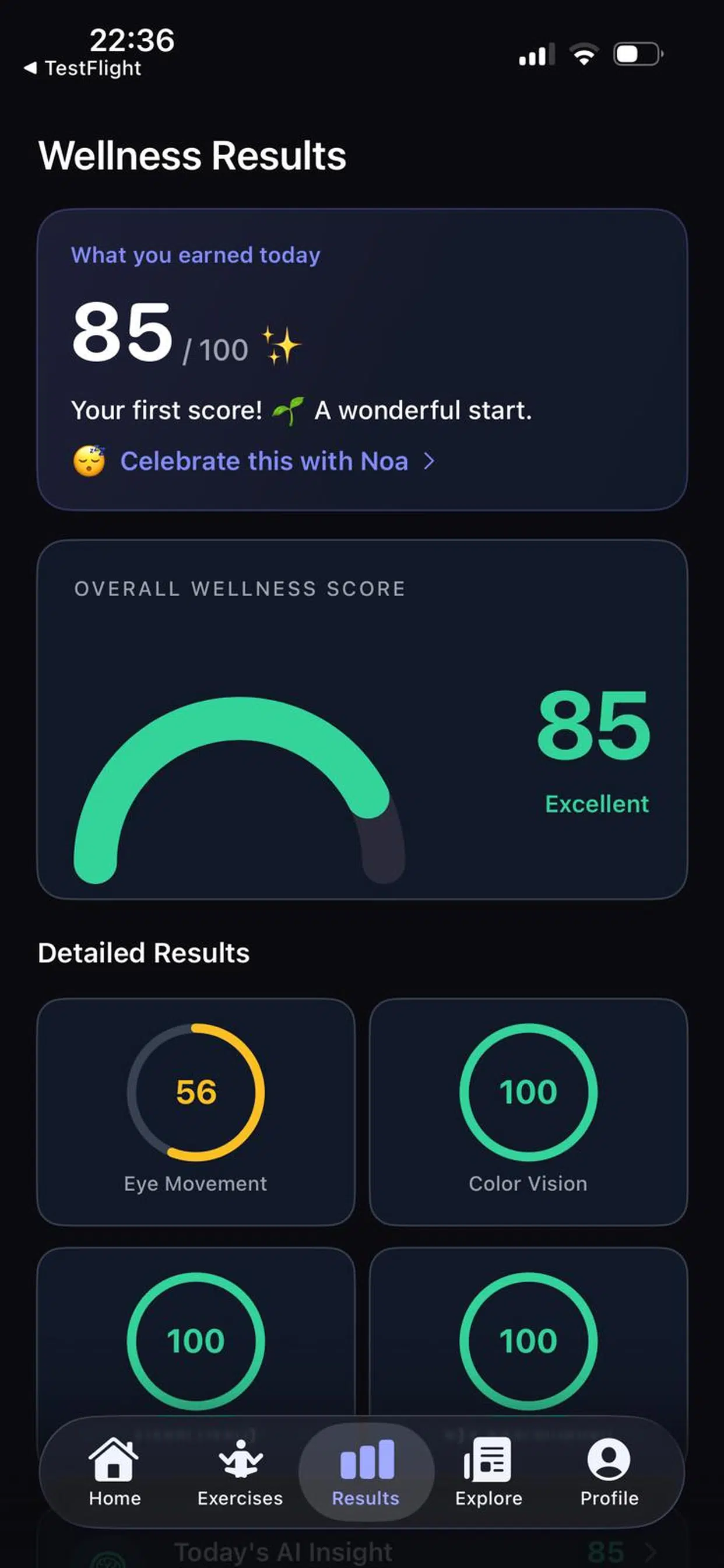
EyeZenith uses your phone’s camera, microphone and motion sensors to take four short readings: eye movement, heart rate variability, ambient noise and steadiness. It combines them into a single daily number and tells you which one to work on first.
Get EyeZenith — free to start
EyeZenith is a wellness product. It is not a medical device, it has not been cleared or approved by the FDA, and it is not intended to diagnose, treat, cure or prevent any disease or medical condition. Readings are estimates from consumer phone sensors, not measurements from clinical instruments. Talk to a qualified professional about any health question or concern.
What you need to start
A phone. That’s the whole list.
Just your phone
EyeZenith runs on the iPhone or Android phone you already have. There is no headband, no chest strap and nothing to buy alongside it. It needs iOS 17 or later; the Android version it requires is stated on the store listing.
Apple Watch optional
If you own an Apple Watch, EyeZenith can read your heart rate variability from it through Apple Health, where the Watch measures it directly. If you don’t, it takes the reading from the rear camera with your finger over the lens. Either way works — the Watch is optional, not required.
What EyeZenith reads
Four readings, each about a minute. You don’t have to do all of them every day.
Eye movement
A short reading session with a live overlay on your eyes. The app derives fixation and eye-movement patterns on your device using Apple’s Vision framework. Camera frames are held in memory while the scan runs and then discarded; only the coordinates are computed.
Heart rate variability
Read from your Apple Watch through Apple Health if you have one, or from the rear camera with your finger over the lens if you don’t. Reported as SDNN.
Ambient noise
A passive loudness reading from the microphone, so a noisy room shows up in your day rather than going unrecorded. This is a consumer-phone reading, not a calibrated sound level meter — you can calibrate it against a reference app if you want a closer number.
Steadiness
Hold your phone still for thirty seconds. The app reports how much it moved.
What it asks you to do next
The four readings produce a number. The number points at one thing to do, and the app walks you through it.
A breathing session
A guided 4-7-8 rhythm, about three minutes.
A reading session
A longer passage with the eye overlay and word-by-word tracking, if reading stamina is something you want to keep an eye on.
An eye break
Twenty seconds of looking away, prompted.
A wind-down
A lower-stimulation routine for the end of the day.
These are what the app suggests, not what it measures. Doing one doesn’t change today’s number; it’s what you do after you’ve seen it.
Why one number
Your phone and your watch already collect a lot. What they don’t do is tell you which of it matters this morning.
Four into one
EyeZenith takes the four readings and reduces them to a single number, then names the one signal that moved most and gives you one thing to do about it — a breathing session, an eye break or a wind-down.
You can see the arithmetic
The scoring is rule-based: fixed thresholds applied to your readings, the same way every time. Tap the number to see the raw readings it came from and which threshold each one crossed. Nothing about it is a black box, and nothing about it is learning from you in the background.
What your phone already does
On iPhone, your phone already warns you when you hold it too close to your face — that’s Screen Distance, in Screen Time, and it’s free. Because EyeZenith needs iOS 17, every iPhone that runs it has that feature. If you have an Apple Watch, it already records your heart rate variability. EyeZenith doesn’t replace either of those. What it adds is the combination: four signals in one place, one number, one next step, and no wearable required for any of it.
What to expect
EyeZenith gives you a record and a routine. What you do with them is the part that matters, and that part is yours.
We don’t publish before-and-after numbers and we don’t run testimonials about results. We could collect flattering ones — most apps can — but a quote from one person tells you nothing about what happens for you, and we’d rather not imply otherwise.
What we can tell you is what the app does: it takes readings, it keeps them, it shows you trends over 7 and 30 days, and it asks you for a few minutes a day.
What stays on your phone
Your camera frames and your audio are processed on your device. They are not uploaded. What leaves your phone is derived numbers — and only if you have turned on score sync.
EyeZenith uses Google Firebase for analytics and crash reporting. Firebase receives technical identifiers, your device model and OS version, and an approximate location derived from your IP address — not your camera frames, not your audio, and not the content of your readings. Exactly what it receives is set out in our Privacy Policy.
If you use the in-app companion, the message you type and an optional personalization context are sent to a large-language-model provider so it can write the reply. Your raw readings are not sent. The Privacy Policy names the providers and what they get.
You can ask us to delete your data at any time: privacy@autotrainbrain.com
Who uses it
People who spend the day on a screen and want a record of what that does to their eyes and their attention
People tracking heart rate variability who don’t own a wearable
People who want a short, fixed routine at the same point every day
Parents who want to sit down with their child and do a reading session together
What it costs
EyeZenith is free to download.
Subscription and cancellation · Privacy Policy · Terms of Service
Who makes EyeZenith
EyeZenith is made by Auto Train Brain Inc., a Delaware corporation, the team behind Auto Train Brain. Our background is in reading and cognitive training software; EyeZenith came out of wanting a phone-only way to keep a daily record.
Auto Train Brain Inc.
320 Cobble Creek Curve, Suite 130
Newark, DE 19702, United States
info@autotrainbrain.com · +1 213 423 0846
EyeZenith is sold on the App Store by HMS Health Mobile Software A.Ş.