




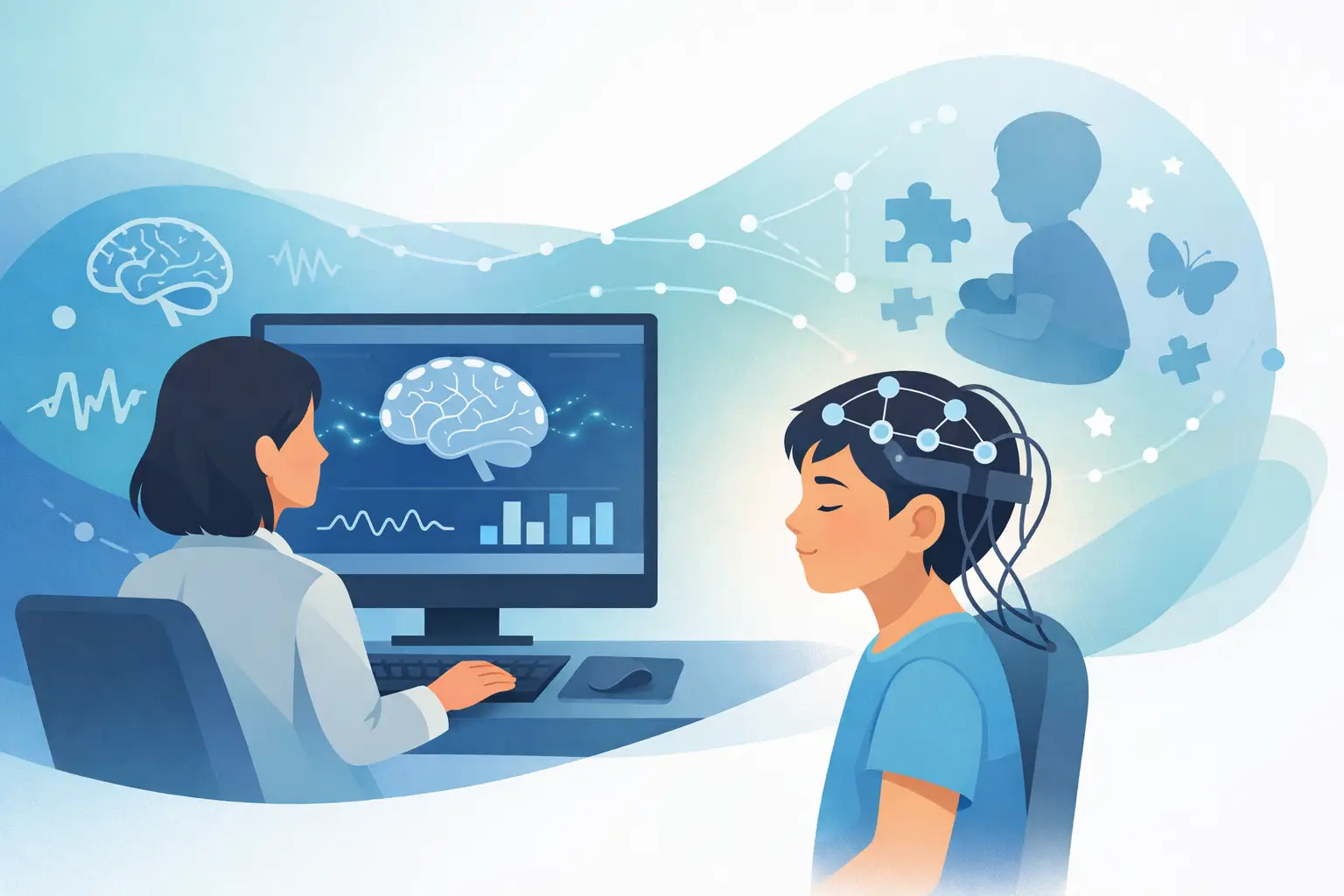
When a child with autism is overwhelmed by noise, struggles to shift attention, or has difficulty settling into learning, parents usually ask a practical question first: can cognitive training help autism in a way that is safe, measurable, and worth the effort? That is the right question to ask, because autism is complex, and no single approach should be presented as a cure. What cognitive training may offer is targeted support for specific challenges such as attention regulation, emotional control, sleep quality, and learning readiness.
Can cognitive training help autism in real life?
In real life, the answer is often yes for some goals, but not in the simplistic way families are sometimes promised. Cognitive training is not a treatment that “removes” autism. It is a brain training method that uses real-time EEG signals to give the brain feedback about its own activity. Over time, with repeated training, the goal is to encourage more efficient patterns of self-regulation.
For children on the autism spectrum, the value of that matters. Many daily struggles are connected not only to social communication differences, but also to regulation difficulties. A child may be bright and capable, yet still find it hard to sustain attention, manage sensory overload, transition between tasks, or stay calm enough to learn. In these cases, cognitive training may help by supporting the underlying regulation systems that affect behavior and performance.
This is why outcomes should be framed carefully. The strongest conversations around cognitive training and autism are usually not about “fixing autism.” They are about whether a child can focus longer, tolerate frustration better, sleep more consistently, or engage in learning with less resistance. Those are meaningful goals for families, schools, and the child.
What cognitive training is actually designed to do
Cognitive training is based on neuroplasticity, the brain’s ability to change through repeated experience. During training, EEG sensors detect brainwave activity, and the system provides visual or auditory feedback when the brain moves toward a target pattern. The process is noninvasive and medication-free.
That matters to many parents because they are not only looking for help, but also for help that feels safe and sustainable. A well-designed cognitive training program is intended to train regulation, not to force behavior. It aims to support attention, processing stability, and self-control in a gradual, measurable way.
For children with autism, this may be especially relevant when the concerns include attention inconsistency, emotional reactivity, impulsivity, sleep disruption, or academic underperformance linked to regulation rather than intellectual ability. In other words, the best candidates are often children whose daily functioning is being limited by how their brain manages input, attention, and response.
What research suggests – and where caution is needed
The research around cognitive training for autism is promising, but it is not uniform. Some studies report improvements in attention, executive functioning, emotional regulation, and certain behavioral symptoms. Parents and clinicians also describe gains in calmer behavior, better task completion, and improved readiness for learning.
At the same time, autism is a broad spectrum. Children differ in communication style, sensory profile, cognitive strengths, co-occurring conditions, and support needs. That means results can vary significantly. A child with autism and clear attention regulation problems may respond differently than a child whose main challenges are social communication or severe sensory distress.
This is where families need a science-based, not sales-driven, explanation. Cognitive training should be viewed as a supportive intervention, not a guaranteed answer. The quality of assessment, the consistency of training, and the clarity of the target goals all affect outcomes. So does the presence of co-occurring conditions such as ADHD, anxiety, learning difficulties, or sleep problems.
A careful provider will never promise that cognitive training supports every feature of autism. A credible conversation sounds more like this: if your child struggles with focus, self-regulation, cognitive flexibility, or learning stamina, cognitive training may help strengthen those areas over time. That is a more accurate and more useful expectation.
Which autism-related challenges may improve
The most realistic benefit areas tend to be the ones that can be observed and tracked. Attention span is one of the most common examples. If a child frequently drifts off, cannot stay with a task, or needs constant redirection, improved regulation may lead to better participation at home and at school.
Another area is emotional control. Some children experience rapid escalation, difficulty recovering after frustration, or intense responses to routine demands. Cognitive training may help the brain become less reactive and more adaptable. For families, that can translate into fewer meltdowns, smoother transitions, and a calmer learning environment.
Sleep is another meaningful target. Poor sleep can worsen attention, irritability, and sensory sensitivity the next day. When sleep improves, many secondary difficulties improve with it. Not every child experiences this benefit, but for some families it becomes one of the most valuable changes.
Academic readiness also matters. Cognitive training does not teach reading, language, or social skills directly. However, if a child can sit longer, process instructions more steadily, and recover from distraction more quickly, other interventions often become more effective. This is one reason some families use cognitive training alongside speech therapy, occupational therapy, behavioral support, or specialized academic instruction.
Can cognitive training help autism if the goal is social development?
It can help indirectly, but that distinction is important. Social communication is influenced by many factors, including language, sensory processing, emotional regulation, and attention to social cues. Cognitive training may support some of the underlying regulation needed for better engagement, but it is not a substitute for direct social, language, or developmental therapies.
For example, a child who is less overwhelmed and more attentive may participate better in conversation practice or therapy sessions. A child who is sleeping better and regulating frustration more effectively may become more available for learning. These are meaningful shifts, but they are support mechanisms, not a direct social skills curriculum.
Parents often appreciate this distinction once it is explained clearly. It lowers unrealistic expectations and helps them identify the right outcome measures from the start.
How families should judge whether it is working
The best way to evaluate cognitive training is through real-life functional markers. Parents should look beyond vague impressions and ask whether daily tasks are changing in observable ways. Is homework taking less time? Is the child staying seated longer? Are transitions smoother? Is there less emotional escalation after minor stress? Is sleep more stable?
Measured progress matters because autism support is often emotionally loaded. When parents are exhausted, even small good days can feel like major proof, while hard weeks can feel like failure. A structured program should track changes across time, not rely on guesswork.
This is also why home-based systems can be valuable when they are guided properly. Consistency is essential in brain training, and regular use often determines whether a child has enough repetition to build change. When an EEG-based program is delivered at home with clinical oversight, families may be better able to maintain frequency without adding the burden of constant travel. Brands such as Auto Train Brain position this model around safety, measurable progress, and structured professional support, which is exactly what families should look for.
When cognitive training may be a good fit
Cognitive training may be worth considering when a child with autism shows attention instability, emotional dysregulation, learning fatigue, sleep problems, or co-occurring ADHD-like symptoms that interfere with daily functioning. It can also make sense for families who want a noninvasive, drug-free option as part of a broader support plan.
It may be less helpful when expectations are unrealistic or when the main goal requires direct teaching rather than regulation support. If the priority is expressive language development, social reciprocity instruction, or adaptive behavior training, cognitive training may play a supportive role but should not be the only intervention.
That is the trade-off families need to understand. Cognitive training can be meaningful, but meaning depends on matching the method to the goal.
What parents should ask before starting
Before beginning any program, ask how goals are defined, how progress is monitored, how often training is expected, and what kind of professional supervision is included. Ask what the provider believes cognitive training can and cannot do for autism. The answer should be clear, balanced, and evidence-aware.
Be cautious of any provider who promises universal results or presents autism as a single, simple problem. Autism is not simple. Good care respects that complexity while still giving families a practical path forward.
For many children, the most valuable question is not whether cognitive training changes a diagnosis. It is whether it helps the child function with more calm, more focus, and more capacity to learn. When that happens, progress often becomes easier to build across the rest of the child’s support plan.
Families do not need exaggerated promises. They need credible options, safe tools, and a way to see whether life is getting easier for their child one meaningful step at a time.
Wellness disclaimer: Auto Train Brain, EyeZenith, ATB Edu, ATB Games, and NeuroSphere are wellness tools designed to support cognitive development. They are not medical devices and do not diagnose, treat, cure, or prevent any condition. Any assessment or medication decision is a healthcare professional’s decision — always consult your physician. Individual results may vary and may not be typical.
Scientific reference: Eroğlu et al. 2020, Applied Neuropsychology: Child. DOI: 10.1080/21622965.2020.1732980
By Dr. Günet Eroğlu, Founder — Auto Train Brain
© 2026 Auto Train Brain Inc. (Delaware, USA) · HMS Health Mobile Software A.Ş. (Turkey) subsidiary
KVKK & Privacy Policy ·
Limit the Use of My Sensitive Personal Information (California) ·
DPO Contact