




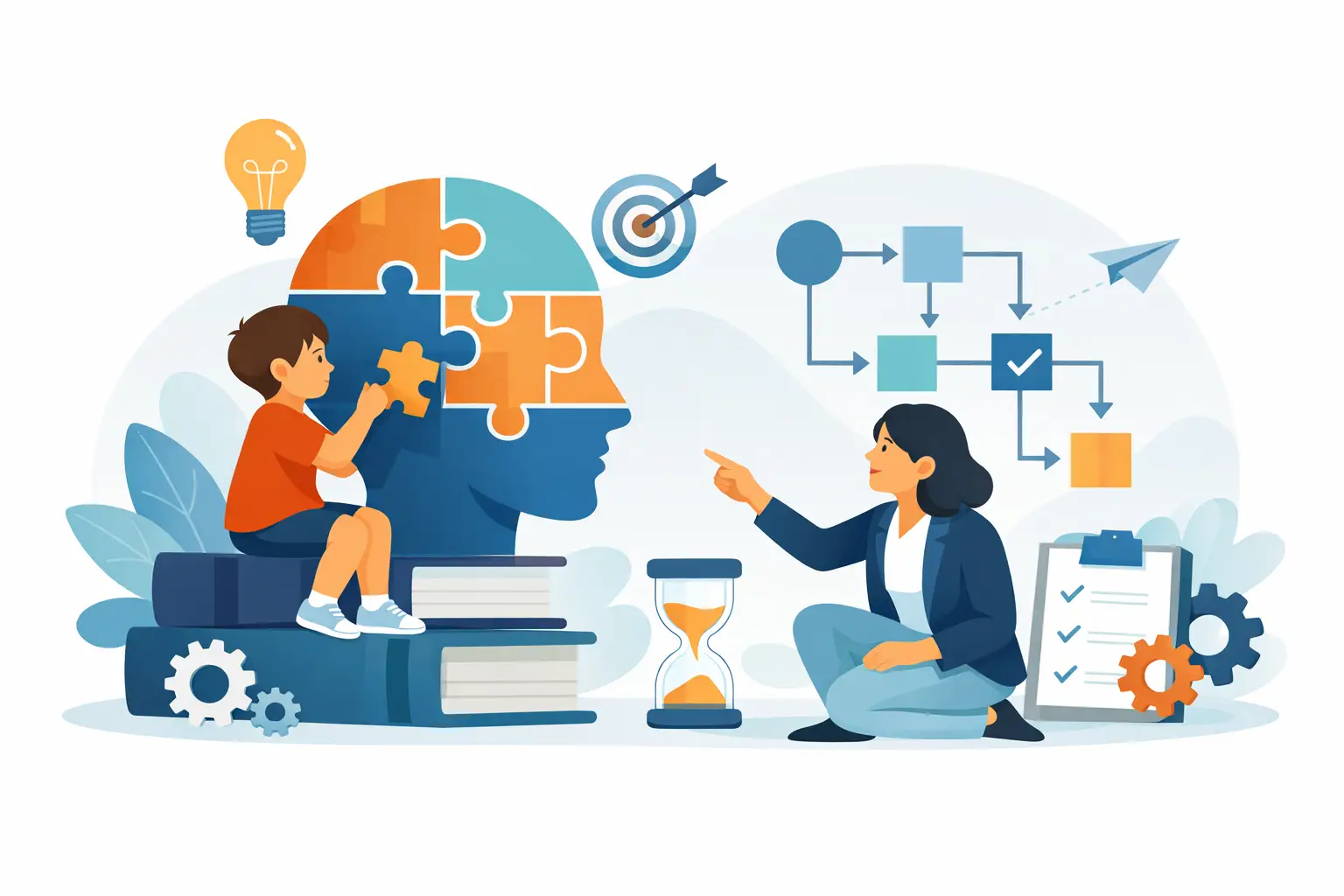
When a child knows the answer but cannot start the worksheet, loses track of simple instructions, or melts down during transitions, the issue is often not effort. It is executive function. That is why executive function training for kids has become a central topic for parents looking for real, measurable support beyond repeated reminders, tutoring, or discipline alone.
Executive function is the brain’s management system. It helps children focus, hold information in mind, shift between tasks, control impulses, organize materials, and follow through. When these skills are weak, school can feel harder than it should. Reading comprehension suffers because the child cannot hold the sentence in working memory. Math errors increase because attention slips mid-problem. Homework turns into conflict because planning and task initiation are inconsistent.
For families of children with ADHD, dyslexia, autism, or learning differences, these challenges are often familiar. The key question is not whether support is needed. It is what kind of training actually helps, what results are realistic, and how parents can tell the difference between short-term coping strategies and genuine cognitive improvement.
What executive function training for kids actually means
Executive function training is not one single activity. It is a structured effort to strengthen the cognitive skills behind everyday performance. Depending on the child, that may include attention regulation, working memory, response inhibition, processing speed, planning, and cognitive flexibility.
The most effective programs do more than teach children to “try harder” or “be organized.” They target the underlying brain-based skills that support those behaviors. This distinction matters. A checklist can help a child remember homework for a while. But if sustained attention and working memory remain weak, the child still struggles whenever demands increase.
That is why parents often see mixed results from traditional supports alone. Tutoring may improve content knowledge. Behavioral coaching may reduce some daily friction. School accommodations may ease pressure. All of these can help, but they do not always train the cognitive system itself.
Why some kids struggle more than others
Executive function develops over time, and no two children follow the exact same path. Age matters, but so do neurodevelopmental differences, stress levels, sleep quality, emotional regulation, and learning demands.
A six-year-old who forgets multi-step directions may be showing normal developmental immaturity. A ten-year-old who still cannot stay with a simple routine, manage materials, or regulate impulses may need closer evaluation. The same is true for a strong reader who cannot plan written work, or a bright student whose test scores collapse under time pressure.
This is where careful, evidence-based support becomes important. Parents need to know whether the issue is mainly behavioral, academic, emotional, or cognitive. In many cases, it is a combination. Good intervention respects that complexity rather than offering one-size-fits-all promises.
What effective training usually includes
Strong executive function support is structured, repeated, and measurable. It should also be appropriate for the child’s age and profile. A preschooler needs something very different from a teenager preparing for exams.
At the practical level, effective training often works on a few core capacities. Sustained attention helps a child stay with a task long enough to complete it. Working memory supports following directions, reading comprehension, and mental problem-solving. Inhibitory control helps reduce blurting, rushing, and emotional overreaction. Cognitive flexibility supports transitions and coping with change.
The format also matters. Many children do better with interactive training than with lecture-style instruction. Real-time feedback can be especially useful because it helps the child connect effort with performance. Repetition matters too, but repetition alone is not enough. The brain responds best when training is targeted, adaptive, and consistent over time.
Can brain-based training improve executive skills?
This is the question most parents ask, and it deserves a careful answer. Some approaches focus on compensatory strategies, such as planners, timers, visual schedules, and parent coaching. These are helpful and often necessary. But they mainly support performance from the outside.
Brain-based approaches aim to improve regulation from the inside by training the neural systems involved in attention and self-control. One example is EEG-based neurofeedback, which uses real-time brain signal information to provide immediate feedback during training. The goal is not to force behavior, but to help the brain learn more efficient regulation patterns through practice.
For the right child, this can be highly relevant to executive function training for kids because executive skills depend on stable attention, self-monitoring, and cognitive control. If those systems become more regulated, improvements may show up in daily life as better focus, fewer task avoidance behaviors, and stronger academic follow-through.
That said, parents should expect nuance, not hype. Results vary based on consistency, baseline profile, age, family support, and whether the program is guided by professionals. Any serious provider should talk about monitoring progress, not magic fixes.
What parents should look for before choosing a program
The strongest programs are transparent about method, timeline, and expected outcomes. They do not hide behind vague language. They explain what skill is being trained, how progress is tracked, and what kind of support the family receives along the way.
Clinical logic matters. If a child has attention dysregulation, weak reading comprehension, and poor task persistence, the intervention should connect those dots. Parents should be able to understand why the approach may help and how success will be measured. Useful indicators include changes in sustained attention, reading speed, comprehension, homework independence, and behavioral regulation.
Safety matters too. Families are often balancing school demands, emotional stress, and concern about side effects from various treatment paths. That is why many seek noninvasive, structured options with a strong scientific foundation. A well-designed EEG-based system, supported by physician and psychologist input, can offer a reassuring combination of safety, guidance, and measurable follow-up.
When training works best
Children make the most progress when the training is regular, the expectations are realistic, and the adults around them are aligned. This does not mean parents need to become therapists. It means the home environment should support consistency.
A child who trains twice and stops will not show the same gains as a child who follows a structured plan for months. Neurocognitive development depends on repetition and adaptation. That is one reason home-based systems can be so valuable for busy families. When training is accessible, guided, and built into weekly life, adherence is usually better.
It also helps when progress is visible. Parents feel calmer when they can see concrete change rather than relying on vague impressions. Small wins matter here. Finishing homework with fewer prompts, staying seated longer, shifting activities with less resistance, or remembering directions more reliably are meaningful signs of executive growth.
What results are realistic
A realistic goal is not perfection. Executive function is not trained once and solved forever. It develops over time and continues maturing into adolescence. The aim is meaningful improvement in the skills that affect daily learning and family life.
For some children, the first changes show up in attention and compliance. For others, the shift is academic. Reading becomes less effortful because focus holds longer. Instructions are followed more accurately. Emotional reactions become less intense because the child has more control in the moment.
Families should also remember that improvement is rarely linear. Some weeks are better than others. Growth can be uneven, especially in children with complex learning or developmental profiles. That does not mean the training is failing. It means progress should be viewed across time, with data and professional interpretation when possible.
This is where a science-based system stands apart from generic brain games. The goal is not just engagement. The goal is measurable cognitive development tied to real-world performance. Brands such as Auto Train Brain position this clearly by focusing on EEG-based training, professional oversight, and outcomes parents can actually observe in schoolwork and daily routines.
A better question than “Will this fix everything?”
Parents under pressure often ask for certainty. That is understandable. When your child is bright but struggling, every school call, missed assignment, and emotional blow-up feels urgent. But the better question is whether a program addresses the real bottleneck with enough structure, safety, and evidence to justify the commitment.
Executive function training for kids is most valuable when it is approached as part of a serious developmental plan. Not a trend. Not a quick hack. A plan that respects the child’s profile, uses measurable methods, and gives the family support they can sustain.
Children do not need louder reminders. They need the right kind of training, delivered consistently, with a clear path to progress. When that happens, the change is not just academic. Daily life gets lighter, conflict decreases, and children begin to experience something every parent wants to see more often – competence.