




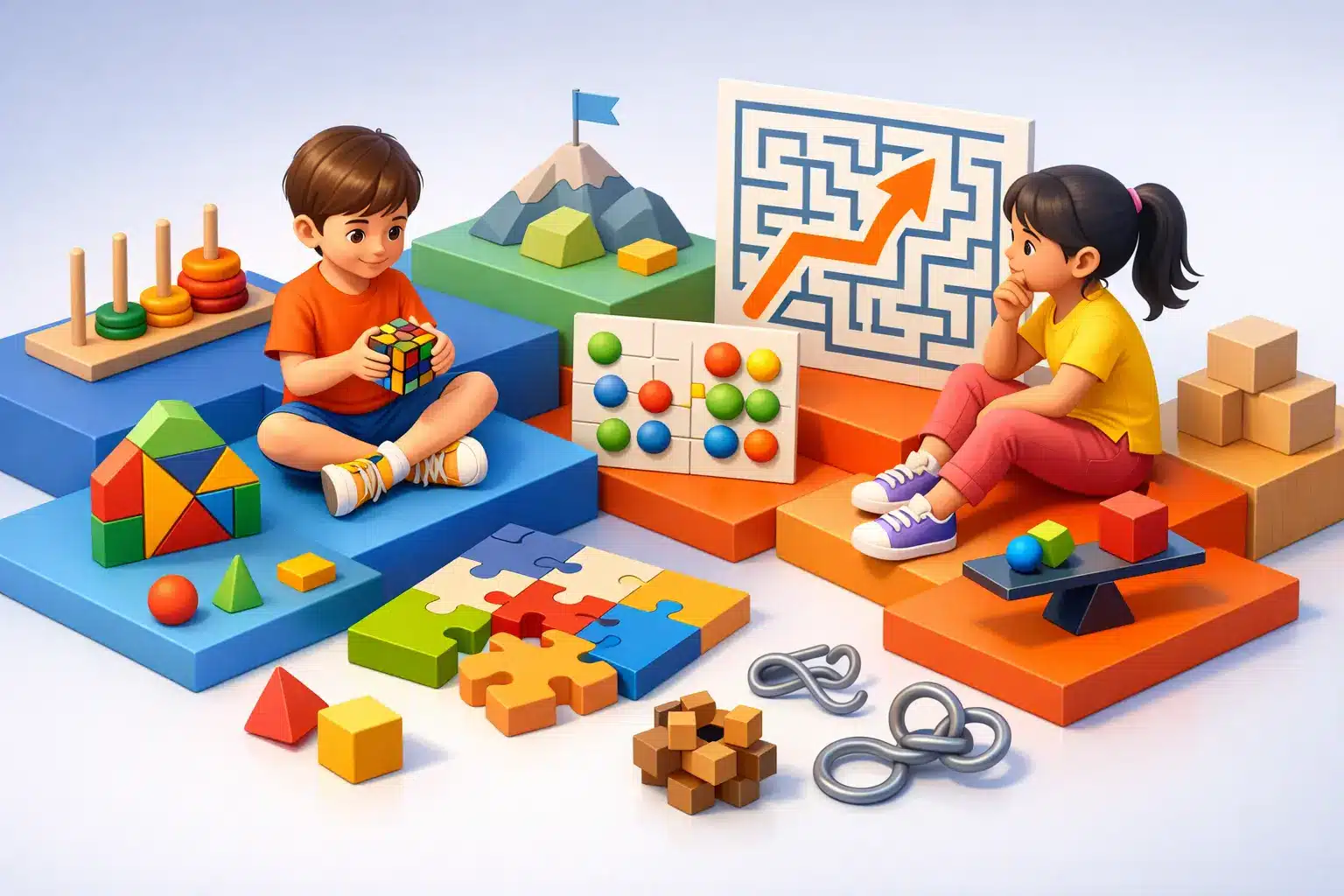
A child who avoids a worksheet may spend 20 determined minutes figuring out why the fox cannot cross the river first. That difference matters. Logic puzzles for kids turn thinking into an active, low-pressure challenge, giving children a reason to pause, test an idea, notice a pattern, and try again.
For parents of children with attention differences, reading challenges, learning differences, or a strong dislike of being corrected, the right puzzle can offer something especially valuable: a chance to practice cognitive skills without feeling like schoolwork. The goal is not to find the hardest brain teaser. It is to choose puzzles that meet your child where they are and make effort feel worthwhile.
Why logic puzzles feel different from drills
A logic puzzle asks a child to use clues, rules, and elimination to reach an answer. Unlike a memorization activity, it usually allows more than one route toward progress. A child may begin by crossing out an impossible choice, spotting a visual pattern, or simply asking, “What do I know for sure?”
That process can support executive-function skills such as working memory, planning, flexible thinking, and persistence. It can also give children an opportunity to build a healthier relationship with mistakes. When an answer does not work, the puzzle has not judged them. It has given them new information.
This is particularly helpful for children who are used to receiving frequent correction during homework. Puzzle time can become a space where adults notice the process, not only the final answer. “You went back to the clue and checked your idea” is often more useful than “You got it right.”
Still, puzzles are not a shortcut to every learning goal. A child who is tired, overwhelmed, or frustrated may need movement, connection, or a break instead. Think of puzzles as one enjoyable part of a broader home learning rhythm.
Choosing logic puzzles for kids by skill, not just age
Age labels are a useful starting point, but they do not tell the whole story. A seven-year-old who loves visual patterns may be ready for a complex grid puzzle, while a ten-year-old with reading difficulties may do better with fewer written clues and more pictures. The best level is one where your child can begin independently, experience a small stretch, and finish with some sense of competence.
Start with visual and hands-on puzzles
For younger children and children who find text-heavy tasks draining, visual puzzles are often the easiest entry point. Picture sequences, matching puzzles, tangrams, mazes, “which one does not belong?” activities, and simple block-placement challenges reduce the reading load while still inviting reasoning.
A useful first question is not “Can my child solve this alone?” Ask, “Can they understand what the puzzle is asking?” If the instructions create confusion, simplify the language, demonstrate one move, or choose a more visual format.
Introduce rule-based puzzles gradually
As children gain confidence, try puzzles with a small number of rules. For example, a child may need to place three animals in three houses without repeating a color or position. Logic grids, number-placement puzzles, and deduction riddles can work well when the clues are short and concrete.
At first, keep the number of variables low. A puzzle with three choices can be satisfying. A puzzle with six people, six pets, six colors, and ten written clues may be too much, even for a bright child. Complexity should grow slowly enough that the child can notice their own progress.
Match the format to your child’s attention style
Some children enjoy sitting quietly with a pencil. Others think more clearly while moving pieces, drawing possibilities, or talking through ideas. There is no single correct puzzle style.
A child with a short attention window may do best with a two-minute riddle, a mini-maze, or one section of a larger challenge. A child who hyperfocuses may enjoy a longer mystery puzzle but need a gentle reminder to pause for water, food, or movement. The puzzle should work with your child’s energy, not compete with it.
A simple way to guide without taking over
The fastest way to make a puzzle feel like a test is to supply the answer. The more helpful approach is to offer a thinking prompt, then wait. Silence can feel uncomfortable for adults, but it gives children room to organize their thoughts.
Try prompts such as: “What clue seems most certain?” “What have you already ruled out?” “Could we test that idea?” or “What would happen if we tried the opposite?” These questions model a repeatable problem-solving process without telling the child what to think.
If frustration rises, lower the demand without abandoning the activity. Cover half the choices. Read the clue aloud. Give two possible starting moves. Or solve the first step together and let your child take the next one. Support is not cheating when it helps a child re-enter the task with dignity.
Be cautious with timed puzzles. A timer can feel exciting for a child who enjoys competition, but it can turn a calming challenge into pressure for another child. Use speed only when your child chooses it and can remain playful about the result.
Make puzzle time easier to repeat
Consistency matters more than long sessions. Ten focused minutes after a snack, during a calm car ride, or before bedtime can be more effective than a weekend session that ends in frustration. Keep a small rotation of puzzle types so the experience stays fresh without requiring a new activity every day.
You can also make the environment do some of the work. Put a puzzle book and pencil in an easy-to-reach spot. Keep reusable visual puzzles on the table. Let your child select between two options rather than asking an open-ended question. Predictable choices reduce friction and give children a sense of ownership.
For siblings, cooperative puzzles are often better than racing to see who finishes first. Invite them to take turns reading clues, moving pieces, or explaining a possible solution. This makes reasoning visible and can reduce the pressure on a child who processes more slowly.
What progress can look like beyond correct answers
Parents often look for a completed page, but meaningful progress can show up earlier. Your child may stay with a challenge for one extra minute. They may ask for a hint instead of quitting. They may begin to use words like “pattern,” “rule,” “possible,” or “doesn’t fit.” Those are signs that problem-solving habits are becoming more available.
A simple observation note can help you notice change without turning family time into a performance review. Once a week, jot down the puzzle type, how much support was needed, and one strategy your child used. Over time, this may reveal useful patterns. Perhaps visual puzzles work best after school, or written riddles are easier when read aloud.
Brain-training wellness practices, including neurofeedback-based approaches, may also be part of some families’ broader efforts to support focus and learning routines. At Auto Train Brain, the emphasis is on measurable, child-centered practice and realistic expectations. Individual needs, interests, and daily capacity should always guide the plan.
When puzzles are not clicking
If your child repeatedly refuses puzzles, do not assume they dislike thinking. The barrier may be the format, the language level, the fear of getting it wrong, or simply the timing. Try a puzzle connected to an existing interest: animal tracks, space clues, sports strategies, maps, codes, or mystery stories.
It may also help to let your child create a puzzle for you. Ask them to make a pattern you must continue, hide an object and write clues, or invent a riddle with three possible answers. Designing a challenge builds reasoning too, and it puts the child in the role of expert.
Not a medical device – does not replace physician advice.
Individual results may vary.
The most valuable puzzle is not necessarily the one your child completes fastest. It is the one that leaves them thinking, “I can try another way,” and choosing to come back tomorrow.