




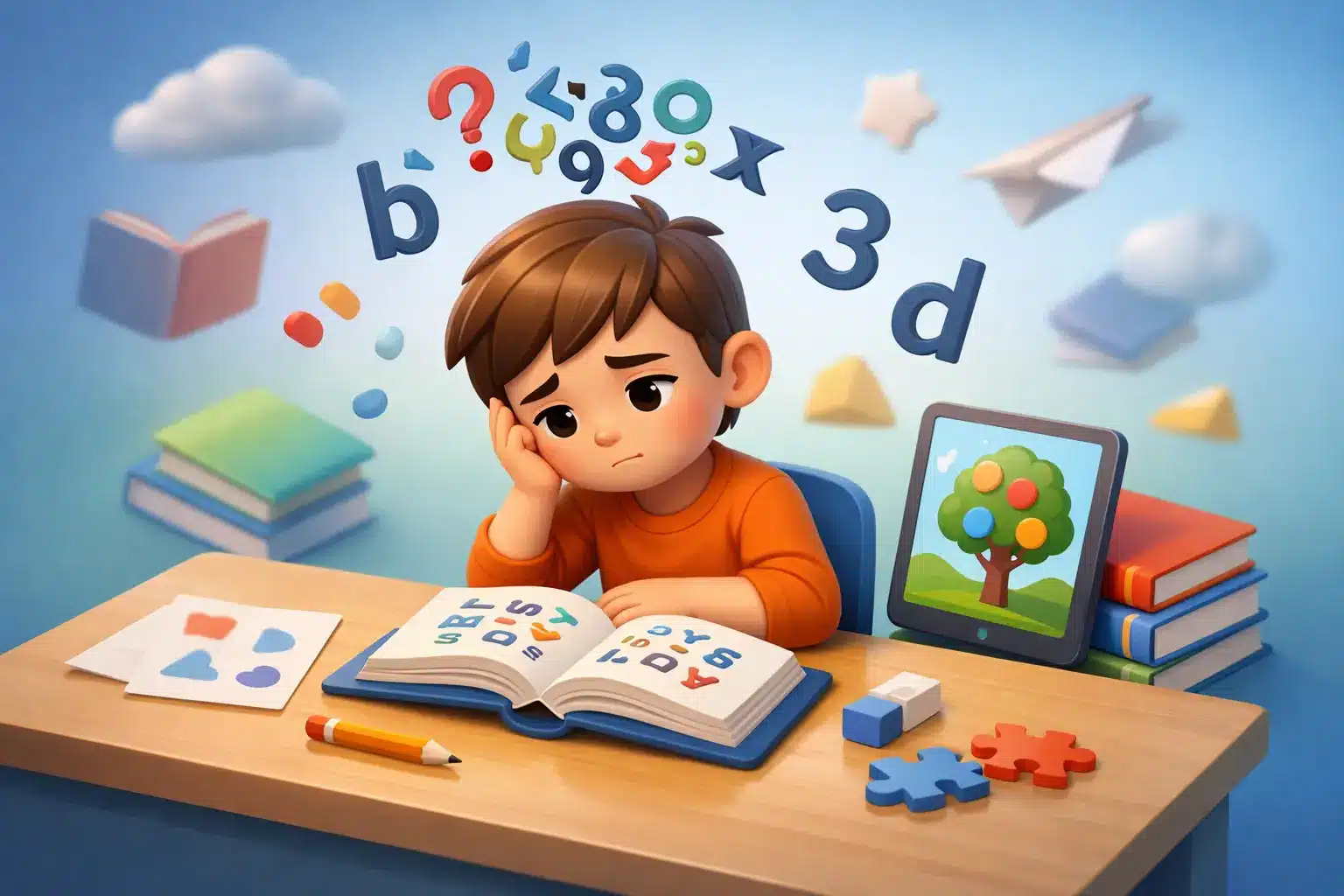
A child who can explain a science topic beautifully but struggles to read a short paragraph aloud is not being lazy or careless. Dyslexia symptoms in children can be subtle at first, especially when a child is bright, imaginative, and working hard to keep up. The earlier families notice a consistent pattern, the sooner they can replace frustration with support, practical strategies, and a more accurate picture of how their child learns.
Dyslexia is a language-based learning difference that can affect reading, spelling, writing, and the ability to connect letters with sounds. It does not reflect intelligence, effort, creativity, or potential. In fact, many children with dyslexia bring strong reasoning, storytelling, problem-solving, and visual thinking skills to the table.
Dyslexia Symptoms in Children by Age
Signs do not look identical in every child, and one difficult week at school is not enough to define a pattern. Look instead for challenges that continue over time, show up in more than one setting, and remain despite regular practice and encouraging instruction.
Preschool and kindergarten: listening, sounds, and early language
Before formal reading begins, some children show that words and speech sounds are harder to organize. They may have trouble learning nursery rhymes, remembering the names of letters, or hearing that cat and hat share an ending sound. Learning the alphabet may take longer than expected, particularly when letter names and the sounds those letters make are taught together.
You may also notice frequent word mix-ups, such as saying “aminal” instead of “animal,” or difficulty recalling familiar words quickly. These behaviors alone do not mean a child has dyslexia. Young children develop at different rates. But when several signs persist and early reading feels unusually effortful, it is worth paying closer attention.
Elementary school: reading becomes a daily battle
Elementary years often make the pattern easier to see because schoolwork increasingly depends on reading fluently and independently. A child may read slowly, skip short words, guess based on the first letter, or lose their place on the page. They might know a word one day and seem unable to recognize it the next.
Spelling can be especially inconsistent. The same word may appear correctly in one sentence and differently in the next. Writing assignments may take far longer than they should because the child must devote so much mental energy to decoding, spelling, and organizing each sentence.
Letter reversals such as b and d can happen for many beginning readers and are not, by themselves, a reliable sign. The more meaningful clue is an ongoing difficulty linking sounds, letters, syllables, and word parts together.
Middle school and beyond: the workload gets heavier
Older children may have learned ways to compensate, which can make their needs less obvious. They may avoid reading aloud, rely heavily on memorization, or spend hours completing assignments that classmates finish quickly. Long reading passages, note-taking, spelling, and written tests can become exhausting.
Some children begin to describe themselves as “bad at school,” even when their verbal understanding is strong. Others may become withdrawn, frustrated, or reluctant to start homework. These emotional signals deserve attention too. They are not proof of dyslexia, but they can show that the current learning demands are costing the child too much confidence and energy.
The Pattern Matters More Than One Mistake
Many parents first notice a collection of small moments: homework ends in tears, reading practice brings avoidance, and spelling tests never seem to stick. The question is not whether your child ever reverses a letter or dislikes a book. The question is whether reading and writing require a level of effort that seems out of proportion to the task.
Pay attention to the gap between what your child knows and what they can easily show on paper. A child may speak with advanced vocabulary, build intricate projects, or contribute thoughtful ideas in conversation, yet struggle to read instructions independently. That gap is useful information for both families and schools.
It also helps to notice what makes the challenge better or worse. Does your child understand a story more easily when it is read aloud? Do short, structured practice sessions work better than long worksheets? Are they more successful when instructions are broken into smaller steps? These observations can guide meaningful support.
What Dyslexia Does Not Mean
Dyslexia is not caused by a lack of effort, poor parenting, too much enthusiasm for screens, or low intelligence. Asking a child to simply “try harder” can make an already demanding task feel like a personal failure.
It is also not useful to frame every reading challenge as dyslexia. Vision difficulties, hearing differences, limited access to consistent instruction, stress, attention challenges, and language development can all affect school performance. A thoughtful educational review looks at the whole child rather than jumping to one explanation.
That nuance matters. Families deserve clear information, and children deserve support that fits their actual learning profile.
What Parents Can Do When They Notice Signs
Start by writing down what you see for two or three weeks. Note the reading task, the type of error, how long it took, and what helped. Bring specific examples to a conversation with your child’s teacher. “Reading is hard” is understandable, but “She can explain the chapter after hearing it, yet takes 25 minutes to read one page and guesses at unfamiliar words” gives the school a clearer starting point.
Ask what the teacher observes during independent reading, spelling, writing, and class discussions. If concerns continue, ask the school about its process for a comprehensive educational evaluation and what learning supports may be available. In the United States, families can also learn about school-based rights and accommodations through IDEA and trusted dyslexia education resources such as the International Dyslexia Association.
At home, protect your child’s relationship with learning. Reading together still counts, including audiobooks, shared reading, and taking turns with a page. Let your child choose books connected to their interests, whether that means graphic novels, sports facts, animals, mysteries, or building projects. The goal is not to force longer sessions. It is to build skills while preserving curiosity and self-belief.
A predictable routine can help: a short reading practice period, a movement break, then a different task. If handwriting slows everything down, allow extra time and consider whether dictating ideas before writing may help your child get thoughts onto the page. Small adjustments are not shortcuts. They are ways to reduce unnecessary friction so effort can go toward learning.
Supporting Attention and Learning Readiness
Reading is not only about recognizing words. A child also needs attention, working memory, emotional regulation, and enough mental energy to stay engaged. Sleep, movement, manageable routines, and breaks from overwhelming homework all support learning readiness.
Some families also explore science-backed brain-training wellness practices that focus on attention and self-regulation. EEG-based neurofeedback, such as the approach used by Auto Train Brain, may support a child’s broader learning routine by providing real-time feedback related to brain activity. It should be approached as an educational wellness practice, alongside school support and guidance from qualified professionals, rather than as a replacement for them.
Progress is rarely a straight line. One week may bring smoother reading; the next may feel harder because the text is more complex or the child is tired. Looking at patterns over months, not individual homework nights, gives families a fairer and more hopeful view of growth.
When Confidence Needs Support Too
Children often notice their struggles long before adults understand why they are happening. A child who says, “I’m stupid,” needs more than reassurance. They need adults to name what is true: learning can be difficult in one area while their strengths remain real and valuable.
Try language that separates the child from the challenge. Instead of “You’re not paying attention,” say, “This word pattern is taking extra work right now. Let’s break it down.” Instead of praising only perfect scores, recognize persistence, strategy use, and the courage to ask for help.
The most useful next step is often not doing more of everything. It is choosing the right support, at the right pace, while helping your child understand that a different learning path is still a path forward.
Not a medical device – does not replace physician advice. Individual results may vary.